Robotics has been particularly lively recently. In the two weeks leading up to this article's original publication in August 2023, several Chinese humanoids were launched. Riding that wave, I put together this overview of major centers of legged robotics in China and overseas. The focus is on the robotics and control community. The AI community using reinforcement learning for embodied intelligence deserves a separate article.
Original article outline
Contents
👇
1. MIT and Boston Dynamics
2. MIT and Cheetah
3. ETH RSL and ANYmal
4. Oregon State, Cassie and Agility
5. UT Austin and Apptronik
6. Caltech AMBER
7. UCLA RoMeLa and Westwood
8. Other overseas universities
9. Other overseas companies
10. Chinese universities
11. Chinese companies
1. MIT and Boston Dynamics
The most influential company in legged robotics is Boston Dynamics. MIT professor Marc Raibert founded it in 1992 as a spinout from MIT, extending the work of his Leg Laboratory at MIT and Carnegie Mellon. The laboratory helped establish the scientific foundations of highly dynamic robots. Boston Dynamics' industry influence needs little introduction: its Spot quadruped and Atlas humanoid are benchmarks in the field.
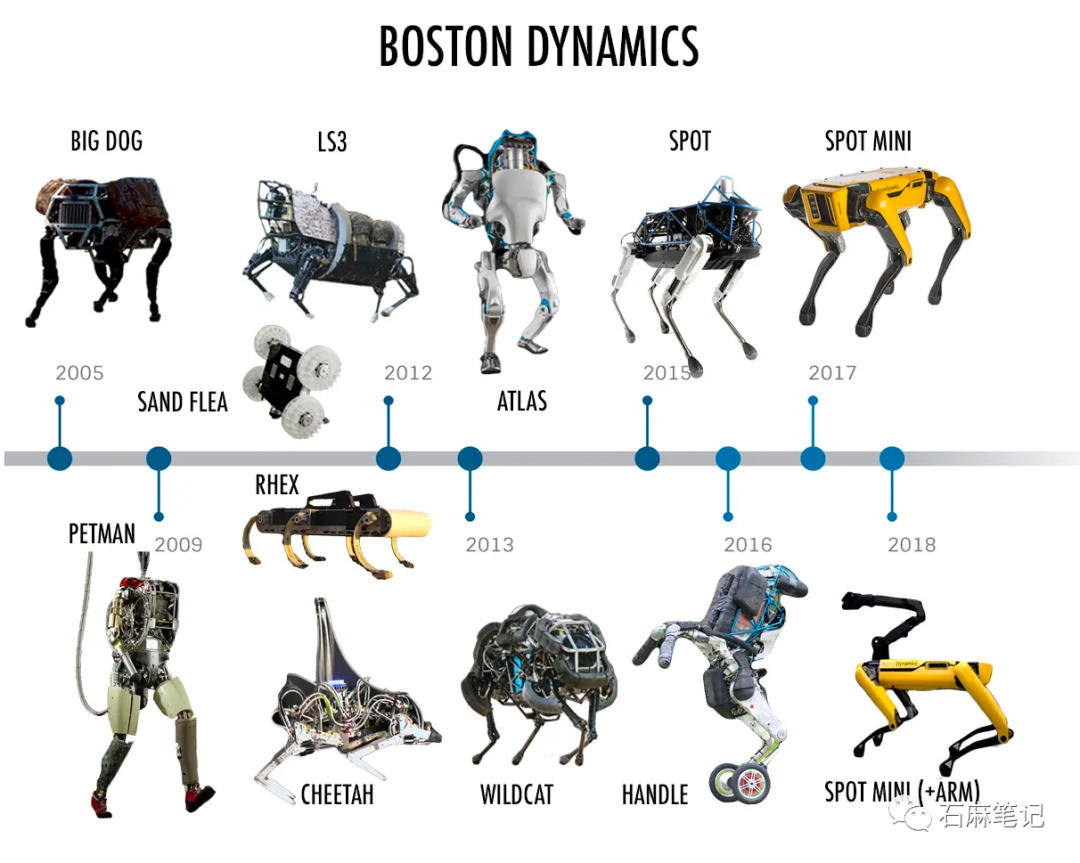
Boston Dynamics product roadmap
2. MIT Mechanical Engineering and Cheetah
MIT's Biomimetic Robotics Lab is the birthplace of the renowned open-source Cheetah quadruped and has formidable hardware expertise. Its director, Sangbae Kim, is a Korean professor in MIT's mechanical engineering department. His research extracts principles from animals for biologically inspired robot design. The open-source contribution referred to here includes the laboratory’s Cheetah robot-control and simulation software; it does not mean that every hardware design in the family is fully open.
The Cheetah family has had enormous influence on legged robotics worldwide. Its open-source contributions underpin much Chinese quadruped development, and its convex MPC controller is widely used. Kim's laboratory mainly produces academic results and open-source contributions rather than directly commercializing them. Its platforms include the Cheetah quadruped and humanoid robots. Cheetah is a leading name among robot dogs, though it is a pity the laboratory did not commercialize it directly.
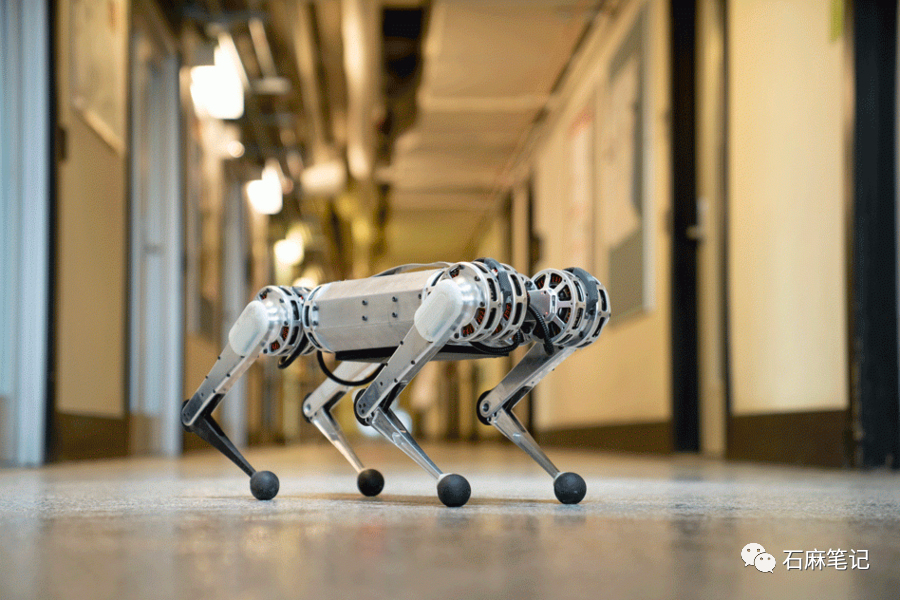
MIT Cheetah
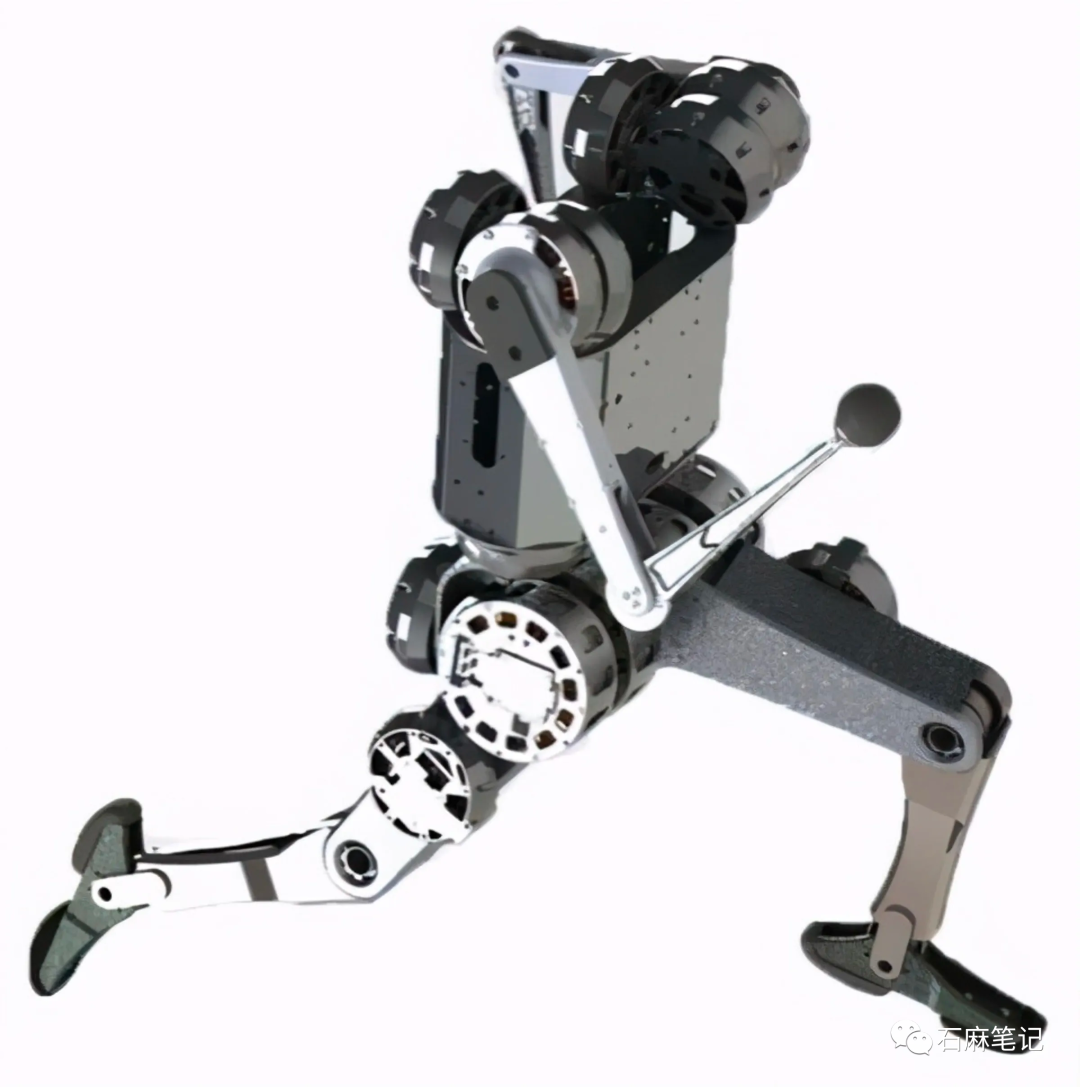
The group also studies humanoids. Its small humanoid was designed for parkour on challenging terrain, and its appearance clearly shows the family resemblance to Cheetah.
3. ETH RSL and ANYmal
ETH's Robotic Systems Lab, or RSL, is the birthplace of ANYmal. To me, it is the strongest legged robotics laboratory in the world—I am reluctant to soften that to one of the strongest. Its leader, Marco Hutter, is a star in the field. Robotics and AI researchers often form separate academic communities, but RSL is unusually good at bringing them together. On the software side, it combines optimal control, including MPC and whole-body control favored by roboticists, with simulation and reinforcement learning favored by AI researchers. On the hardware side, it develops its own force-torque sensors and joints. In a word, there is no weak link.
RSL's platforms cover an extraordinary range: the ANYmal quadruped; ANYmal on Wheels; the lightweight DynaArm; ALMA, a quadruped with an arm; the autonomous HEAP excavator; SpaceBok, a lightweight quadruped for space exploration; force-torque sensors; ANYdrive series-elastic leg actuators; DynaDrive quasi-direct-drive actuators for arms or wheeled legs; and the ANYexo upper-body exoskeleton. These results have also produced impressive spinouts, including ANYbotics for the ANYmal quadrupeds, Bota Systems for sensors, Gravis Robotics for autonomous excavators and RaiSim for robot simulation.
ANYbotics was founded in 2016 as an ETH spinout to commercialize the technology behind ANYmal.
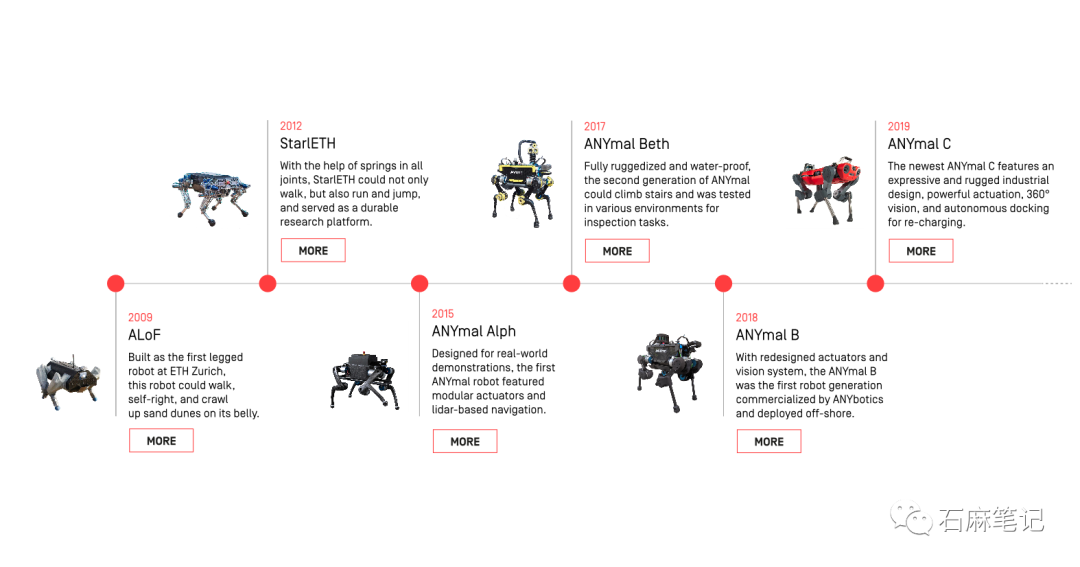
The ANYmal quadruped family
Bota Systems was co-founded by RSL's Klajd Lika, Ilias Patsiaouras and Marco Hutter. It grew from years of research into six-axis force-torque sensing for robotics and develops and manufactures multi-axis force-torque sensors, torque sensors and customized sensors.
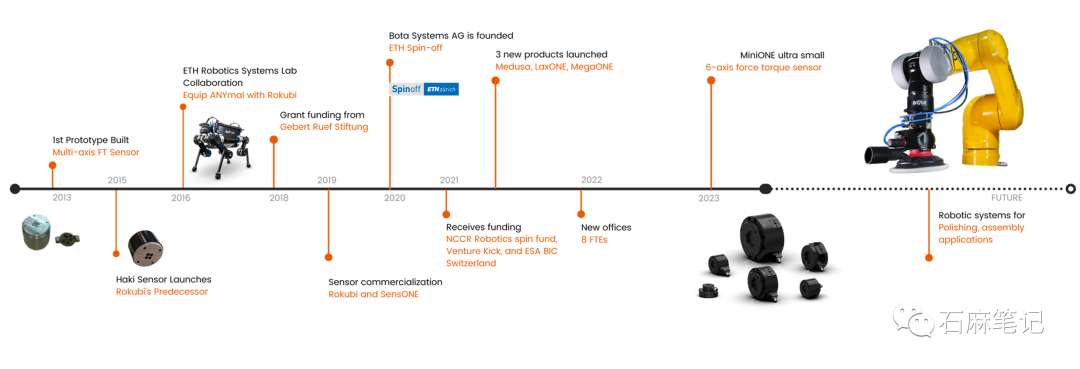
Bota force-torque sensors
With nearly a decade of research experience in automating heavy machinery, Gravis Robotics aims to bring automation to an industry facing slow or stagnant productivity growth and a worldwide labor shortage.
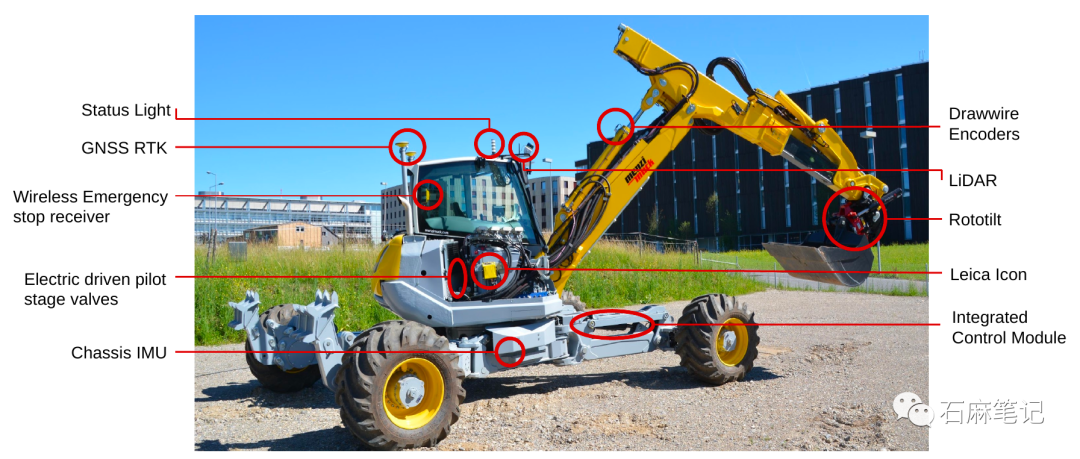
Gravis autonomous excavator
RaiSim is an RSL spinout developing a cross-platform multibody physics engine for robotics and AI. It supports Linux, macOS and Windows, emphasizing both accuracy and speed in robot simulation. It is also a general-purpose rigid-body simulator capable of efficiently simulating arbitrary rigid bodies.
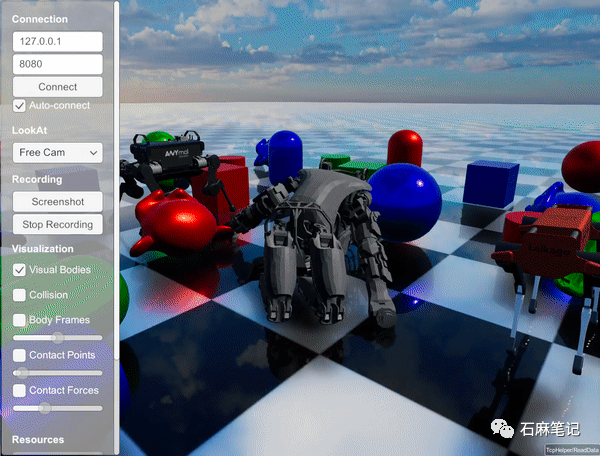
RaiSim rigid-body simulation engine
4. Oregon State, Cassie and Agility
Jonathan Hurst's laboratory at Oregon State University developed the celebrated biped Cassie. Hurst is also Agility Robotics' co-founder and chief technology officer. He earned a bachelor's degree in mechanical engineering and master's and doctoral degrees in robotics at Carnegie Mellon.
With $1.6 million in DARPA funding, Hurst developed Cassie in sixteen months. The dynamic biped walks and runs in a manner resembling people or animals, with bent joints reminiscent of an ostrich's legs. It operates without cameras or external sensing, essentially moving without vision, and can handle varied, complex terrain. The original article regards these capabilities as particularly well suited to search and rescue or parcel delivery. Cassie also achieved a Guinness World Record for the fastest 100 meters by a bipedal robot. Editorial note: the original text gives the DARPA grant as $1.6 million. Oregon State’s own September 2022 account reports $1 million over sixteen months; it also reports a 24.73-second 100-meter run.
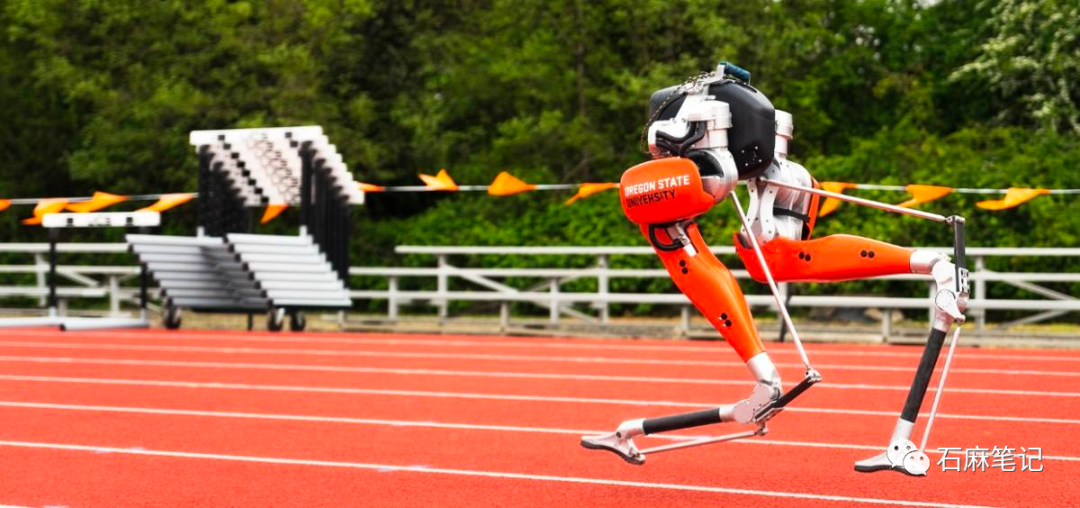
Cassie
Agility Robotics is an Oregon State spinout and Cassie's manufacturer. Its humanoid inherits Cassie's ostrich-like legs. The company aims to build machines that work alongside people in human spaces, primarily in logistics and warehouses. At the time of the original article, it had raised $178.8 million across four rounds. Its most recent round then was a Series B on April 22, 2022, with investors including TDK Ventures, DCVC and Amazon.
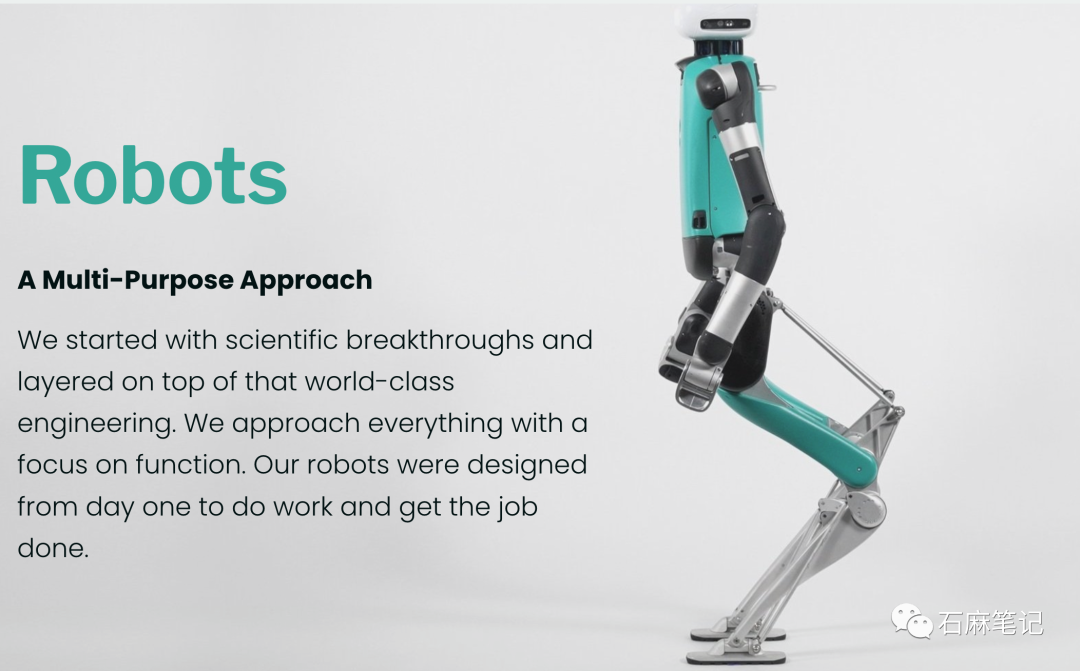
Agility Robotics humanoid
5. UT Austin and Apptronik
UT Austin's Human Centered Robotics Laboratory has many years of humanoid experience. Its director, Luis Sentis, led the university's DARPA Robotics Challenge collaboration with NASA's Johnson Space Center, helping design and test the Valkyrie humanoid.
Apptronik spun out of that laboratory in early 2016 to develop next-generation human-centered robots that operate in close contact with people and change how we live and work. Its platforms include the separate Astra upper body and Draco lower body. When this article was written, I could not find its latest complete humanoid on the website; the forthcoming Apollo might be that platform. In June 2022, Apptronik announced a $14.6 million seed round with Capital Factory, Grit Ventures, Perot Jain and other strategic investors.
Astra is Apptronik's humanoid upper body. Advanced actuation is packaged into a compact form that can be mounted on any mobile platform.
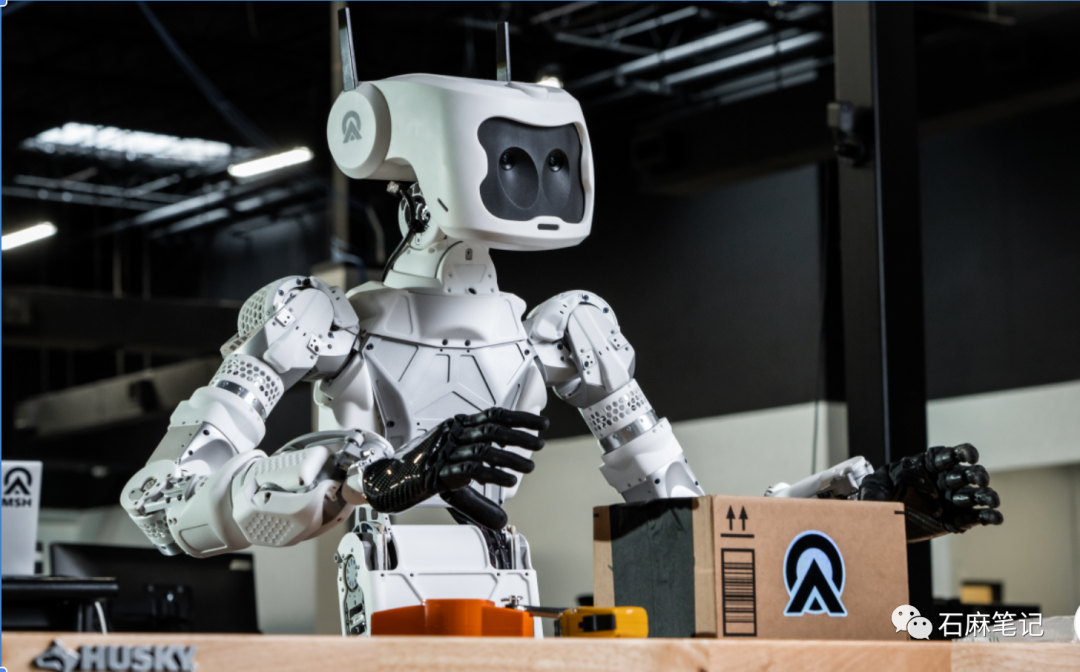
Astra upper-body robot
Draco is Apptronik's first biped: a liquid-cooled, high-performance platform with ten degrees of freedom. It can serve as the base for a humanoid system. Accessible low-level control software and libraries for real-time Linux and ROS simplify integration. Designed for speed and power, Draco targets agile, dynamic walking.
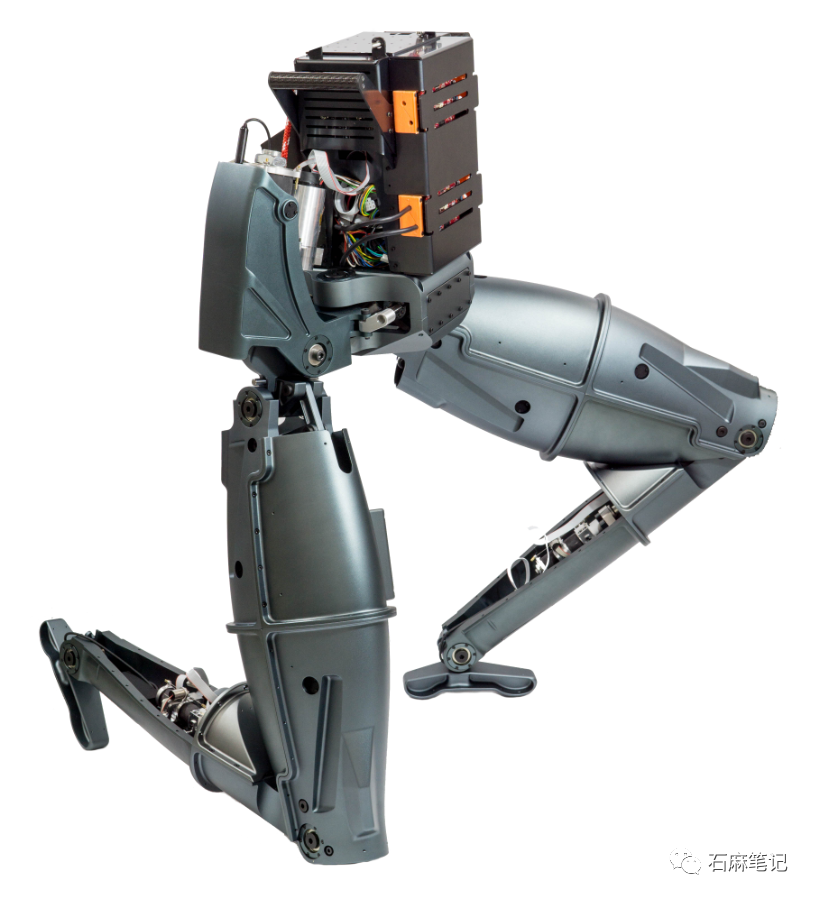
Draco lower-body robot
During 2012–2013, members of the team later associated with Apptronik were selected for NASA's DARPA Robotics Challenge effort to develop Valkyrie. Apptronik’s distinctive linear actuators were used in several parts of the robot. Valkyrie has 44 degrees of freedom, with series-elastic actuators in most joints. The original describes this as the “Apptronik team”; this refers to the team’s earlier work, since the company was founded in 2016.
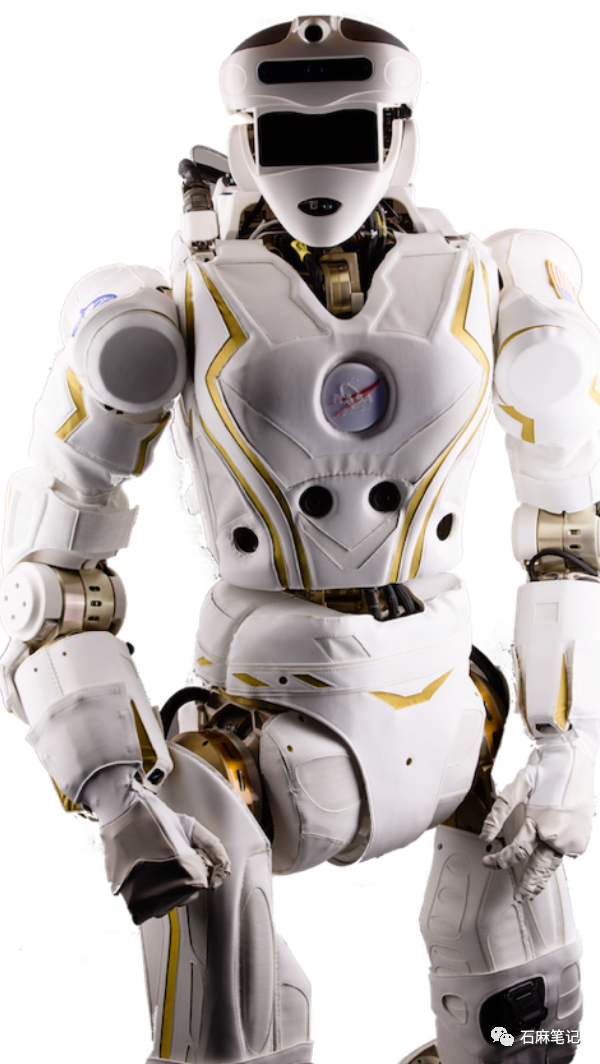
The Valkyrie humanoid
6. Caltech AMBER
The Advanced Mechanical Bipedal Experimental Robotics Lab, or AMBER, is at Caltech, affiliated with Mechanical and Civil Engineering and with Control and Dynamical Systems within Computing and Mathematical Sciences. Led by Aaron Ames, it studies bipedal robots, gait, nonlinear and hybrid systems, and prosthesis design through theory and experiments. The team's bipedal gaits look remarkably human-like.
A Caltech biped
7. UCLA RoMeLa and Westwood
UCLA's Robotics and Mechanisms Laboratory, RoMeLa, is an active center in North American robotics. Its founding director, Korean-American professor Dennis Hong, studies robot locomotion and manipulation, autonomous vehicles and humanoids. Its most prominent recent result at the time of this article was the ARTEMIS humanoid.
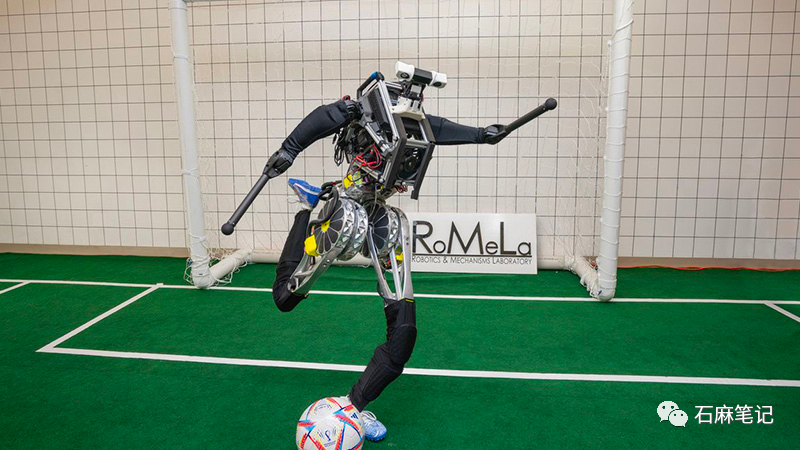
ARTEMIS by RoMeLa
Before ARTEMIS, RoMeLa introduced many humanoids, including CHARLI, described as the first full-size autonomous humanoid in the United States; DARwIn-OP, an open miniature platform for research, education and outreach; and THOR-RD, the Tactical Hazardous Operations Robot–Rapid Deployment for disaster response. The following video shows these platforms.
RoMeLa humanoid robots
Beyond humanoids, RoMeLa has produced a rich range of robots. Examples include OmnUR, a unicycle robot with an active omnidirectional wheel; hexapods and quadrupeds; DAVID, an automated vehicle designed to let a blind person drive; the CARL-2 cooking robot; the pneumatically powered RAPHaEL dexterous hand; and DanTE, a bio-inspired three-fingered manipulator.
RoMeLa is also the birthplace of the open-source BRUCE humanoid. This child-size research and education platform was developed with Westwood Robotics. Founded in 2018 and based in Los Angeles, Westwood was established by Xiaoguang Zhang, a PhD student of Dennis Hong, with its core team coming from RoMeLa. The following video introduces BRUCE.
BRUCE by Westwood and RoMeLa
8. Other overseas universities
Other influential North American centers include Carnegie Mellon’s Robotic Exploration Lab, which the original article abbreviates as “CMU RI” and likens to a Whampoa Military Academy for robotics—a place that trains many of the field’s leading figures. Editorial clarification: CMU RI means the Robotics Institute, and the Robotic Exploration Lab is one laboratory within it. UC Berkeley’s Koushil Sreenath also has extensive work in quadrupeds, while Pieter Abbeel’s laboratory focuses more on reinforcement learning. See my earlier article, Covariant: An AI-for-Robotics Unicorn Founded by Three Chinese Researchers. An overview of embodied intelligence from an AI perspective would merit another article; this one focuses on groups with physical robot platforms.
9. Other overseas companies
Figure
Founded in 2022, Figure had quietly developed a bipedal humanoid during the preceding six months before unveiling Figure 01. In May 2023, it announced its first external funding round: $70 million led by Parkway Venture Capital.
Founder Brett Adcock started Figure with his own money, investing $10 million in 2022 alone. He previously founded and sold recruitment platform Vettery and founded electric vertical takeoff and landing company Archer Aviation, which went public through a SPAC. He remained a major shareholder but had left his company role nine months before this article. He was then fully focused on Figure and said he might invest more than $100 million in it.

Figure 01
1X
Founded in 2014 and based in Norway, 1X was formerly Halodi Robotics. In March 2023, it announced a $23.5 million Series A2 led by OpenAI, with Tiger Global, ADT Capital and Nvidia also participating. After nine years of operation, the new funding was intended to accelerate production of its bipedal NEO and expand manufacturing of its first commercially available humanoid, EVE, in Norway and North America. The following video shows EVE. Editorial note: the original names ADT Capital and Nvidia as participants. The company’s announcement identifies the OpenAI Startup Fund, Tiger Global, Sandwater, Alliance Ventures and Skagerak Capital; ADT Capital and Nvidia are not listed in that announcement.
EVE, a wheeled humanoid by 1X
At the time of the article, 1X's website showed EVE, a humanoid on a wheeled base, and NEO, a legged humanoid. EVE was already commercially usable, while NEO had not yet launched.

NEO, a legged humanoid by 1X
Sanctuary AI
Sanctuary AI is a Canadian company founded in 2018. Founder Geordie Rose is a serial entrepreneur who also founded D-Wave, described in the original as the world’s first quantum computing company. Its two products at the time were the Carbon AI control system and Phoenix humanoid. In March 2022, Sanctuary announced a Series A of nearly $60 million. Eight months later, it disclosed a $30 million Canadian government investment, bringing total funding above $100 million. Currency clarification: the Series A announcement gives C$75.5 million, equivalent to US$58.5 million; the government contribution was C$30 million. The original’s “above $100 million” total does not specify a currency and should not be read as a verified US-dollar total.
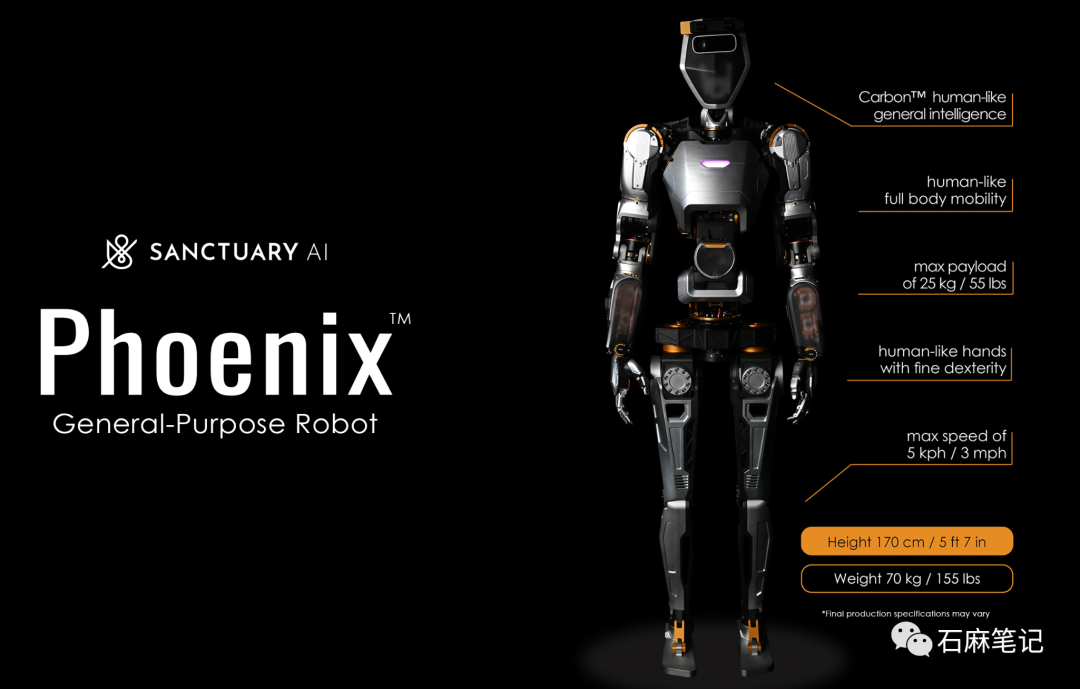
Other overseas humanoid efforts include Tesla's Optimus and Google's Everyday Robots. They are too well known to discuss individually here.
10. Chinese universities
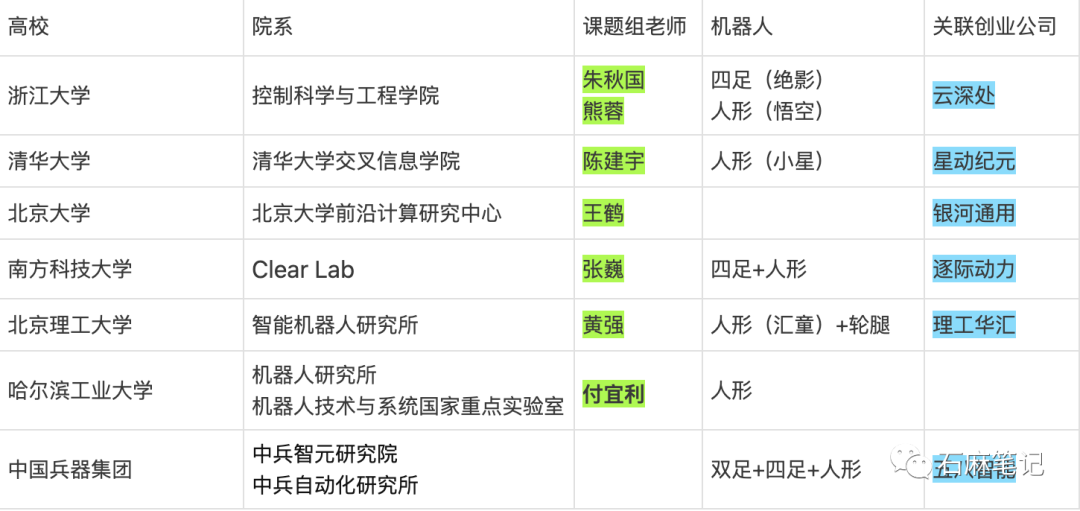
China also has excellent universities and research institutes working on legged robots. The following illustration presents our overview.
11. Chinese companies
Chinese legged robotics companies with established results or considerable investor attention include the following.
Agibot: the humanoid project associated with former Huawei standout Zhihui Jun. Its recent debut at the World Robot Conference attracted widespread technology media attention.
Leju Robotics: a legged robotics company with roots at Harbin Institute of Technology. Chairman and CTO Leng Xiaokun and CEO Chang Lin both earned PhDs there.
Unitree: its quadrupeds are popular with universities in China and abroad, and it had recently introduced a humanoid as well.
Xiaomi: it had recently released a new CyberDog quadruped and the CyberOne humanoid.
UBTECH: its humanoids probably have the greatest public visibility in China, appearing frequently in televised shows and performances.
Fourier Intelligence: it began with exoskeletons, moved into medical equipment and recently introduced a humanoid, becoming one of the Chinese humanoid companies attracting attention.
Other humanoid companies include CloudMinds and Gangtiexia. We will continue updating and expanding this map of legged robotics; reader suggestions and additions are welcome.
12. A few personal reflections
This account rarely discusses Chinese companies and mostly covers American ones—call it worshipping foreign things if you like. I originally planned to expand the Chinese university and startup sections, but found it difficult. Some projects are our investments; others are companies we have assessed or are still considering. It is hard to judge what to write, so I kept that part brief.
Robotics is one of the sectors I have studied most systematically as a venture investor, especially during 2017–2019. We invested in some good companies and regrettably missed others that are now doing very well. After 2021, for various reasons, I largely stepped back from primary-market investing until I began looking at new projects again late last year. I found it hard to catch up with newer fields such as new energy and materials. SaaS, which I had studied for a while, was also in a downturn, with limited institutional investment. I felt quite lost. Even a few months ago, I thought my robotics label was outdated. Yet venture investing follows shifting winds, and suddenly the wind returned to robotics and AI. A hot market is harder to invest in: everyone is chasing deals, and good teams command high valuations. In 2017–2019, many excellent robotics teams had reasonable valuations. Backing dependable teams then could produce very good returns today.
References
https://www.zhihu.com/question/586585019/answer/2926231520
https://www.youtube.com/@leggedrobotics
https://engineering.oregonstate.edu/people/jonathan-hurst
https://agilityrobotics.com/about
https://apptronik.com/about-us/
http://www.bipedalrobotics.com/
https://en.wikipedia.org/wiki/Boston_Dynamics#LS3
https://www.figure.ai/master-plan
https://www.youtube.com/user/ProfAmes
https://www.mae.ucla.edu/dennis-hongs-artemis-highlighted-by-reuters-others/
https://www.westwoodrobotics.io/bruce/