When Smart Note goes quiet, it usually means something new is taking shape. Welcome to our new Open Source Hardware series, or OSH—our third ongoing series, following Robot Data, whose first season concluded with EP10: Robot Data Season One Interview Roundup, and Robot Foundation Model, introduced in RFM EP01: Pi and the Pi0 Embodied Foundation Model. What makes OSH different is that, alongside interviews with the creators, we will also try building their projects ourselves. This gives readers a more direct comparison between the creators' demonstrations and a user's own results, and lets us see whether these open-source robotics projects really work. For our first episode, we chose ToddlerBot, an open-source small humanoid from Stanford.
ToddlerBot (https://toddlerbot.github.io/) is a low-cost, open-source humanoid designed for robotics and AI research, with a cost of about $6,000. Its two joint first authors are Haochen Shi (https://hshi74.github.io/) and Weizhuo Wang (http://me.weizhuowang.com/). At the time of this interview, Haochen is a second-year computer science PhD student at Stanford, advised by Karen Liu and Shuran Song. Weizhuo is a third-year robotics PhD student at Stanford, jointly advised by Monroe Kennedy III and C. Karen Liu. Thank you both for accepting my interview invitation and advising us on reproducing the project. Our ToddlerBot build was completed by Yuhan and Jinbiao from the Xiamen University robotics team.
Original article outline
Contents
👇
1. Introducing ToddlerBot
2. Why build an open-source small humanoid?
3. Hardware design
4. Why use servo motors for a small humanoid?
5. Locomotion algorithms
6. Manipulation algorithms
7. Open-source robots and commercial competition
8. Other features of ToddlerBot
9. Acknowledgements
10. A short survey
1. Introducing ToddlerBot
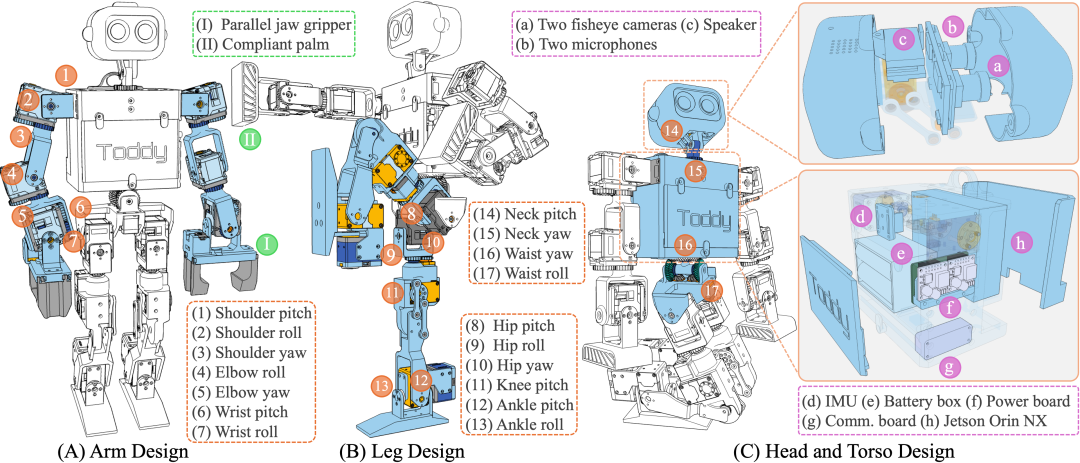
ToddlerBot is a low-cost, open-source humanoid platform designed for scalable policy learning and research in robotics and AI. It stands 56 cm tall, weighs 3.4 kg and has 30 active degrees of freedom: seven in each arm, six in each leg, two in the neck and two in the waist. Green markers in the diagram indicate two end-effector designs: a compliant palm and a parallel-jaw gripper. Purple markers show the sensor and electronics layout in an exploded view, including two fisheye cameras, a speaker, two microphones, an inertial measurement unit (IMU) and a Jetson Orin NX computer. Purchasing all the components and producing the 3D-printed structural parts costs approximately $6,000.
ToddlerBot: the creators' demonstration, by Haochen and Weizhuo at Stanford
ToddlerBot: our reproduction, by Yuhan and Jinbiao at Xiamen University
2. Why build an open-source small humanoid?
We first wanted to build an open-source humanoid at CoRL 2023. Walking around the conference, we noticed that there were not many papers on humanoid robots, even though people online seemed very interested in humanoid research. What was preventing researchers from exploring this area? At that point, people could not buy Unitree's H1 or G1 as they can today. We realized that hardware was the central problem: most researchers lacked a usable platform on which to innovate in algorithms. Many humanoid platforms had existed before, but most did not meet the needs of today's AI research. We felt a humanoid platform for AI algorithms should be relatively inexpensive, easy to use, durable, accessible to newcomers and easy to repair. It should support reinforcement learning for locomotion with sim-to-real transfer, as well as behavior cloning for manipulation.
I have always liked the LEAP Hand project. I even built one at home and found it worked well. That made me feel that open-source hardware could be an influential direction and make a real contribution to the research community.
So we asked ourselves whether we could build an open-source humanoid. When we first discussed it with our advisers, they felt it would be too difficult: there had already been several attempts at open-source humanoids, and most had not succeeded. Still, we believed we could do it. From the start, we established a core goal: it had to be open-source, and other researchers had to be able to reproduce our results.
Throughout the process, we kept that premise at the center of our work, continuously improving and iterating on performance. Eventually, we built a humanoid that could perform a range of locomotion and manipulation tasks and could also be reproduced by other people.
3. Hardware design
The human body has a great many muscles, and it is impossible to perfectly reproduce its structure with only a few dozen motors. But all those muscles ultimately act on specific joints. Our analysis suggested that approximately 32 joints are the most important for human movement.
We wanted a versatile robot, so we paid close attention to the number of degrees of freedom and tried to include all those it would need. Each arm, for example, has seven degrees of freedom, whereas humanoid arms often have only four to six. Each ankle has two degrees of freedom, and the upper leg includes all three. That part of the design went through roughly five or six versions. We are still working on improvements and expect to release a better design soon.
We originally planned three degrees of freedom in the waist, but technical difficulties led us to implement two: lateral bending and rotation around the Z axis. We omitted forward bending because hip pitch already provides that movement. To support future interaction with people and new movements, we gave the neck two degrees of freedom for turning and pitching the head. We may add lateral head tilt if it becomes necessary. Overall, the robot has 30 degrees of freedom. For comparison, Unitree's G1 has 29.
To make the robot reproducible, we also wanted it to be as small as possible. Miniaturization has clear benefits: it requires less equipment and space, and it can be built on a desk. After optimization, we settled on a height of about 55 cm and a weight of just 3.5 kg, so it can easily be lifted with one hand.
A smaller robot can move more nimbly thanks to higher power density, and it is also safer. In a home, a robot this small is unlikely to hurt a child or a pet; the robot is more likely to be damaged by them. Its size and weight also make development easier. If something goes wrong, you can simply pick it up by hand.
Current AI algorithms are essentially black boxes, making it difficult to guarantee safety at the algorithmic level. Keeping the robot small helps reduce the consequences of failures. Full-size robots, by comparison, carry risks in research and educational settings. If a control policy goes wrong, the robot may perform dangerous movements that harm people or its surroundings.
Our central design principles are therefore the smallest practical size, enough degrees of freedom and high reproducibility. To further improve reproducibility, all structural components other than the motors are 3D-printed. Lathes and CNC machining equipment are inconvenient to use at home, whereas the rapid development of 3D printing now makes home fabrication possible.
We have also seen incidents around us in which unexpected movements from full-size robots injured people. That is very dangerous, and we hope these design choices help avoid such risks.
4. Why use servo motors for a small humanoid?
We use conventional geared servo motors rather than quasi-direct drive, or QDD. There is a physical reason for this. When a motor is very small, its internal coil windings must be extremely thin. They cannot carry a large current, so higher voltage is needed to increase speed, while the available torque remains very limited. Under these conditions, a conventional brushless motor does not actually perform very differently from an ordinary servo motor.
At this scale, QDD may therefore offer fewer advantages than servos. Our rough estimate is that a robot around 80 cm tall could be a sweet spot for QDD. In our assessment, a smaller robot of this design cannot use QDD effectively.
Here, a servo refers to a unit containing a small coreless motor and a high-ratio gearbox. A coreless motor can rotate as soon as power is supplied, so its control circuit is relatively simple. The encoder is usually mounted at the output shaft and has comparatively low precision. A defining feature of these servos is their very high reduction ratio, usually far higher than in QDD. That distinguishes them from QDD systems using frameless torque motors. QDD motors commonly have reduction ratios between 5:1 and 40:1, while servos may reach several hundred to one or more. This high-ratio assembly is usually enclosed in a rectangular housing, with a structure and performance quite different from QDD. Technical note: This describes the high-ratio servo design being discussed, not a universal definition of a servo. Servo actuators may use different motor types; the ratios and size threshold above are the interviewees' engineering estimates.
5. Locomotion algorithms
Our reinforcement learning approach is fairly standard. We first build a servo model through system identification, or sysid, fitting its parameters with position-tracking data.
We then use those fitted parameters to adjust the dynamics parameters in MuJoCo, including the URDF-related model parameters, so that the model reflects reality as accurately as possible.
Next, we train an RL policy with extensive domain randomization. During training, we use the zero-moment point, or ZMP, to generate a reference motion for the policy to track.
Once the policy is trained in simulation, we can deploy it directly if the system-identified digital twin is accurate enough and the domain randomization parameters are well tuned. The goal is to make simulation and the real world extremely similar. Then, if something works in simulation, it will generally work about as well in real life.
System identification gives us a set of parameters that accurately describe the motor's characteristics, which we then use in simulation. Each motor has its own properties, and different models behave differently. A motor has inertia, a maximum achievable speed and a certain torque capacity, for example. These characteristics must be explicitly represented in the simulator so that the policy can understand how the motor will respond to a particular position target.
6. Manipulation algorithms
The robot has many joints, so controlling it with a joystick or similar interfaces is difficult. We are also exploring teleoperation with VR and motion capture. That work is ongoing, and we may release the results later.
For now, we use an ALOHA-style interface because we know it can collect reliably high-quality data. Training a diffusion policy with that data gives us a better success rate.
ALOHA-style control means using two robots with the same structure: the movements of one are copied to the other in real time. People generally refer to this arrangement as ALOHA-style teleoperation.
7. Open-source robots and commercial competition
It is difficult for a commercial company to make everything fully open-source, because ultimately it earns money by selling hardware. Buying an assembled robot is certainly more convenient for someone who does not want to build it from scratch. But humanoids inevitably get damaged. If you bought a complete robot, it may be difficult to repair yourself: you may need custom replacement parts from the manufacturer. Unless the company achieves a high degree of modularity, repair remains a problem.
A fully open-source robot has clear advantages. With ours, if a part breaks, you can simply 3D-print it again. That is one benefit of open source. Robot repairs are almost unavoidable, especially for humanoids, which inevitably need various forms of maintenance.
In my view, assembling an open-source robot is itself a form of practical training. Working on it yourself improves your skills and gives you a deeper understanding of how the robot works. When a problem occurs, you can quickly locate the fault. That is extremely useful for future development.
Buying a complete robot package is convenient, but for academic researchers and developers, gaining hands-on skills and a deep understanding of the robot is equally important—even essential.
8. Other features of ToddlerBot
One distinctive choice in our design is that the arms and legs have comparable strength. Most humanoids prioritize legged locomotion, resulting in strong legs but weaker arms with fewer degrees of freedom. Our robot is different: its arms are about as strong as its legs, so it can easily perform movements such as pull-ups and push-ups.
We may develop more dynamic tasks in the future, so we planned for that from the outset. We deliberately made the structure more robust and included many expansion interfaces to leave room for further development.
Human–robot interaction is another particularly interesting aspect of humanoids. Strictly speaking, for specific practical tasks, a humanoid may not have an advantage over a wheeled or quadruped robot in a given setting. Humanoids are often described as the most general-purpose form, but that generality depends on algorithms and control becoming fully mature.
Personally, I think the humanoid's most striking advantage is its resemblance to a person. This gives it distinctive strengths in human interaction. We are therefore considering developing the robot further in a social direction, so it can interact more naturally with children and adults. Its cute humanoid appearance may make people more willing to accept it and start interacting naturally with it.
There is an element of product thinking in this idea, but it can also provide a platform on which developers can continue improving human–robot interaction.
Many earlier social robots only had a few preprogrammed movements or skills. Simple feedback caused them to repeat preset trajectories, but that is far from general-purpose interaction. To achieve genuinely natural and general interaction, we may need large models, using real human–robot interaction data to fine-tune foundation models and pursue deeper research.
To me, the most exciting thing about ToddlerBot is that more students will participate in developing and using the platform, continuously improving its software and hardware. I am looking forward to seeing what ToddlerBot becomes in a few years.
9. Acknowledgements
Special thanks to DJ and AJ, two friends of ten years, for supporting our ToddlerBot reproduction with equipment. I also want to thank Yuhan and Jinbiao from the Xiamen University robotics team, the two younger alumni who did the main work on our build. And, of course, thank you to my teacher, Hu Tianlin, the team's faculty adviser, for his continued support.
We will select another nine open-source hardware projects to reproduce and will continue improving and iterating on these platforms. Recommendations for good open-source hardware projects are welcome. We also particularly need people who understand robot joints, mechanical body design and motion control algorithms.
10. A short survey
Do you think small humanoids, approximately 50–70 cm tall, are valuable? Options: Yes; No.
What kind of development support do you prefer? Options: Open-source hardware/software; Modular design; A complete SDK; Community support.
Have you developed a small humanoid robot before? Options: Yes; No.
Would you participate in early testing or crowdfunding for a small humanoid? Options: Yes; No.
What price range would you accept? Options: RMB 2,000–5,000; RMB 5,000–10,000; RMB 10,000–20,000; RMB 20,000–30,000.
Are you a student or currently working? Options: Undergraduate student; Graduate student; Software development engineer; Robotics hardware development engineer; Other employed role.
Would you prefer a small humanoid to use servo motors or dedicated joint actuators? Options: Servo motors; Joint actuators.
Original poll: please take part in the original WeChat article.