As March 2025 gets underway, and robotics is already buzzing. Alongside spectacular humanoid demos—dancing, backflips and kip-ups—embodied AI companies have been busy: Physical Intelligence released Hi Robot, Figure unveiled Helix, Google introduced Gemini Robotics, AgiBot released GO-1, and NVIDIA announced GR00T N1 at GTC. These announcements have brought a bewildering collection of concepts with them. What exactly are these so-called VLA models? How do they differ? What is the relationship between VLA and imitation learning? And where does the importance of real-robot data come in?
After a few months without an update to the Robot Foundation Model series—RFM EP01: Physical Intelligence and the π0 Embodied Foundation Model; RFM EP02: Octo; and RFM EP03: Tsinghua's RDT and a Comparison of Embodied Foundation Model Architectures—requests from readers in the account's inbox have finally brought us to Episode 4.
I have organized the architectures of several leading VLA models and my understanding of the concepts behind them. In addition to working through the architectures myself, I interviewed Chiming Liu, a co-first author of AgiBot's Genie Operator-1, or GO-1, to check the architectural details and clarify the terminology. I hope this can become the most accessible introduction to VLA on the Chinese-language internet.
At the time of this interview, Chiming Liu worked at AgiBot, where he was responsible for foundation model architecture and R&D. He is a co-first author of AgiBot World Colosseo and led the development of the GO-1 foundation model. Previously, he held technical expert positions at Alibaba and Tencent, developing machine learning and deep learning for large-scale internet systems. He has developed and trained LLMs with hundreds of billions of parameters, published related work at leading conferences and journals, and contributed to numerous open-source communities, including major projects such as huggingface/transformers.
Original article outline
Contents
↓
1. What is VLA?
2. Understanding the π0 VLA architecture
3. Understanding Figure's Helix VLA architecture
4. Understanding AgiBot's GO-1 VLA architecture
5. Some thoughts on general-purpose manipulation
1. What is VLA?
VLA is a multimodal model that combines vision, language and action to help robots understand and execute tasks more naturally. The aim is for a robot to do things by looking at images and understanding instructions, much as a person does.
In traditional control systems, vision, language and action are often handled by separate modules. A VLA model tries to bring them into a unified architecture, maintaining continuity and consistency from perception through images, to understanding through language, to execution through actions. A VLA model typically includes the following components.
Part 1: Vision encoder. It takes visual signals such as images and video and encodes them as feature vectors. Common choices include ViT, or Vision Transformer, ResNet and more advanced image models.
Part 2: Language encoder. It takes a natural-language instruction and converts it into a text embedding. Examples include BERT, T5, GPT and the CLIP text encoder.
Part 3: Cross-modal fusion. It aligns image and text information and learns the relationships between vision and language. This can involve cross-attention, a multimodal Transformer or CLIP-style contrastive learning.
Part 4: Action decoder or policy head. Using the fused visual and linguistic features, it produces action commands, which can be continuous control vectors or discrete tokens. Actions may be generated through diffusion, flow matching, an RL policy head or other methods.
If we trace where the core capabilities come from, Parts 1 through 3 draw on the vision-language models, or VLMs, developed by foundation model companies such as OpenAI and Google. Part 4 draws on the robotics capabilities developed by embodied AI companies, exemplified here by Physical Intelligence and π0.
For a concrete picture, imagine a well-trained robotic assistant. It sees an image of a kitchen table with a plate, a fork and an egg. You tell it, 'Flip the egg.' It understands your words and considers them together with what it sees: Where is the egg? How should its hand move? Which tool should it use? It then acts, performing a precise sequence such as picking up a spatula and turning the egg over. In this process, visual perception, language understanding and action control work together seamlessly.
2. The π0 VLA architecture
In the RFM, or Robot Foundation Model, series, we put together an introduction to π0 based on several talks by Sergey Levine: RFM EP01: Physical Intelligence and the π0 Embodied Foundation Model. Physical Intelligence's published description explains that its generalist robot policy builds on a pretrained vision-language model and a diverse, cross-embodiment manipulation dataset. For robot control, the model incorporates a separate action expert that generates continuous actions through flow matching, enabling precise, smooth manipulation. The model can be prompted for zero-shot control or fine-tuned on high-quality data for complex, multistage tasks, such as folding multiple garments or assembling a box.
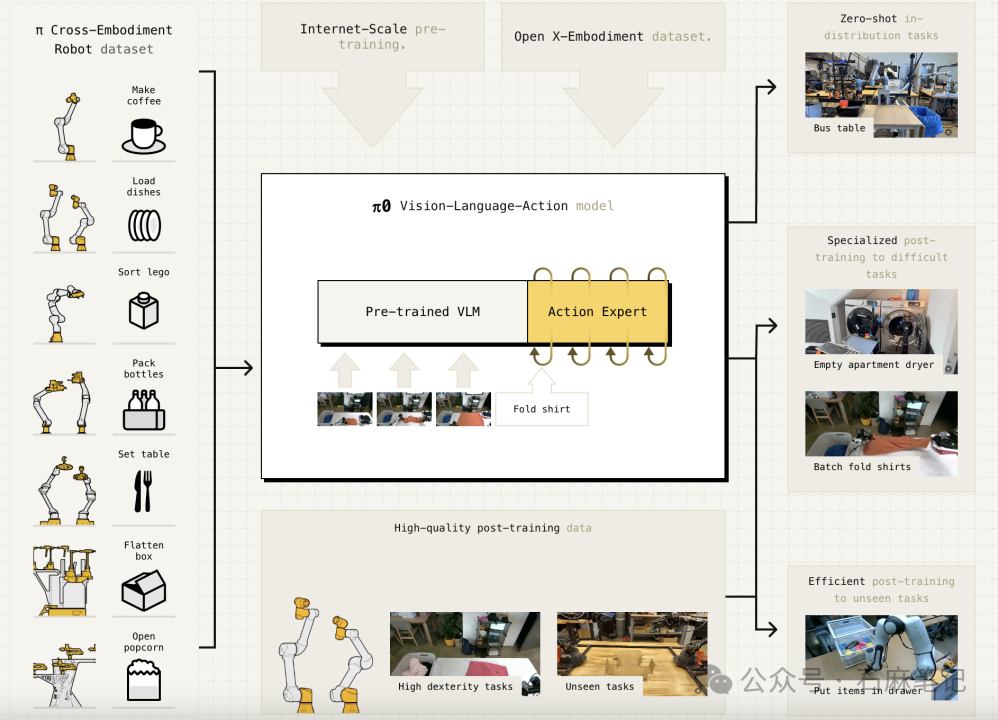
Once you understand the architecture, that description is quite precise. Without that background, however, some of its concepts are difficult to make sense of. Combining my own understanding with the interview, I have broken the π0 architecture down below.
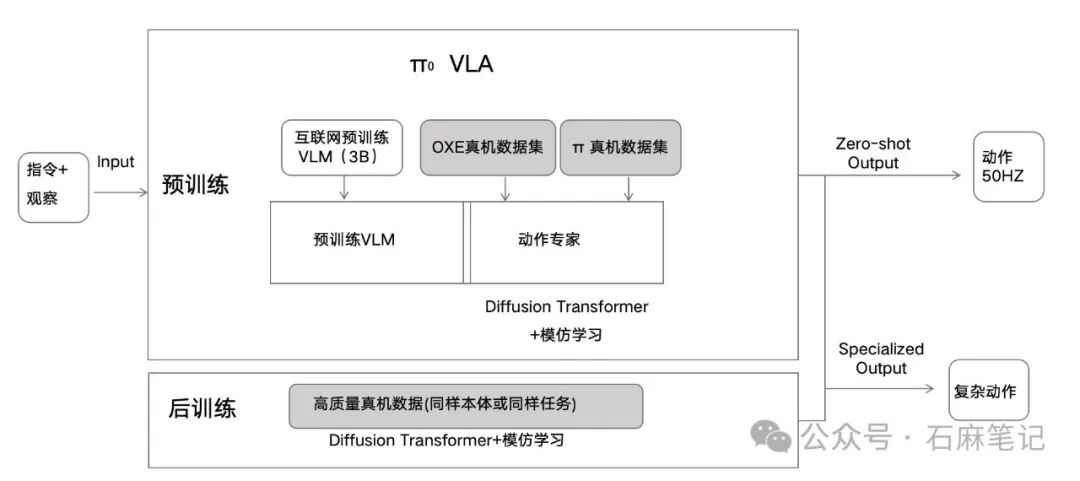
Here is how I understand the overall architecture in my own words. π0 is an end-to-end VLA model that directly produces actions from a robot's observations and a human instruction. Training has two stages. During pretraining, it builds on a VLM developed by a foundation model company, with its existing understanding of visual and textual information, and learns a robot action policy through imitation learning supervised by real-robot data. During post-training, it uses imitation learning again to improve success on particular tasks. Let us unpack that description.
VLA: inputs and outputs
Using the public π0 materials and the interview, we worked through the architecture shown above. At the far left, the model receives the robot's visual observations and language instructions. At the far right, it outputs robot actions. In simple terms, a robot receives an instruction, combines it with visual information about its surroundings, and produces the actions needed to carry out the task. These functions are integrated within one large neural network—the sense in which the model is called end-to-end. The robot then receives new observations as it acts, closing the perception–action loop.
The π0 VLA architecture
Training has two main stages: pretraining and post-training. They differ in training scale and in the quality required of the output. Like a VLM, the pretrained policy takes images and text as inputs, but it also receives the robot's own state, including joint angles.
Pretraining
Pretraining has two main components supported by three kinds of data. The first component is a VLM already pretrained on internet-scale data. More generally, such a VLM may be available as an open model or through an API. In π0, the team selected Google's PaliGemma 3B weights. PI did not develop that original VLM; it chose a suitable model developed by another company.
The second component is an action expert trained using two broad sources of real-robot data: open datasets such as OXE and PI's own high-quality teleoperated robot data. In the imitation learning framework, the model is optimized against supervision from these demonstrations. It uses flow matching, a generative approach related to diffusion, to turn noisy action representations into continuous action outputs.
The pretrained VLM
The pretrained VLM in π0 refers to Google's open PaliGemma model: a set of roughly three-billion-parameter weights learned from internet-scale image and text data. One point needs clarification: the word 'pretrain' can mean different things in different fields. Even when we are discussing VLM pretraining, its specific meaning depends on the context.
PaliGemma, for example, is built on Gemma. Gemma is a language model from Google. PaliGemma adds a vision encoder to that language model and trains the combination further to form a vision-language model, establishing alignment between text and vision.
The Physical Intelligence team did not train a VLM from scratch on internet-scale image–text data. It started with Google's pretrained PaliGemma weights and trained the resulting robot policy on a large robot dataset to obtain π0. Editorial correction: the Chinese original gives approximately 100,000 hours; the original π0 paper reports about 10,000 hours of PI demonstrations, supplemented by open robot datasets.
The action expert
The action expert uses flow matching. At an intuitive level, it resembles a diffusion model, although its training objective differs. It is conditioned on information from the VLM's Transformer layers: hidden states, or feature vectors, associated with the image and text tokens. LLMs and VLMs use Transformer architectures in which token representations acquire hidden states as they pass through successive layers. The action expert uses that contextual information to generate control commands through an iterative generative process. Editorial clarification: the original describes denoising these VLM vectors themselves. More precisely, flow matching transforms a noisy action chunk into actions, conditioned on the VLM representations; the VLM hidden states are not the noisy actions being denoised.
Zero-shot capability
The pretrained VLA has some zero-shot control capability. The situation shown in the diagram generally concerns tasks already represented in training—the in-distribution tasks. A policy built on a VLM can also have some generalization ability, including handling objects not encountered during robot training. That is another sense in which it can demonstrate zero-shot capability.
Post-training
The second training stage is post-training. It uses PI's own high-quality real-robot data in an imitation learning framework to improve success on particular tasks. This resembles refining a generalist into a specialist with a higher success rate: a transition from general-purpose capability to task-specific expertise.
Here, real-robot data refers to a way of obtaining robot demonstrations, usually by having people teleoperate the robot. There are several methods, including mechanically matched teleoperation such as Mobile ALOHA and headset-based teleoperation such as Open-TeleVision.
In what sense is VLA an end-to-end imitation learning framework?
Overall, this particular VLA approach is end-to-end imitation learning. Its supervision comes from actions recorded while people teleoperate robots. The action expert generates actions through its denoising or flow-based process, and a loss is computed to optimize the model by backpropagation. The demonstration actions provide the targets: they are the actual robot actions recorded during human teleoperation. This is where imitation learning's supervision enters. In flow matching, that supervision is expressed through the generative training objective rather than simply comparing a final sampled trajectory with a demonstration.
Does end-to-end imitation learning apply only to the action expert?
During this robot-policy training, the model uses an imitation learning objective rather than adding other kinds of objectives. For example, VLM training commonly uses cross-entropy between predicted and target tokens. That separate token-level objective is not used here; the robot policy is trained from action supervision through the flow-matching loss. The fact that this supervision enters through action generation does not mean that only the action expert can be optimized: the training is end-to-end. The earlier pretraining of the original VLM is a separate stage with its own objectives.
How should we understand 'diffusion Transformer'?
It is useful to distinguish a generic diffusion Transformer from DiT as the name of a specific architecture introduced by researchers at Meta. The model discussed here also uses a Transformer-based generative architecture, but it is not simply that original DiT implementation. Calling it a diffusion Transformer in the broader descriptive sense is reasonable; calling it DiT without qualification can be confusing. More precisely, π0's action-generation objective is flow matching.
Post-training versus pretraining
The action expert uses the same architecture during π0 pretraining and post-training. The difference emphasized here is the training data. Post-training uses higher-quality, more targeted real-robot data to improve task success—for example, demonstrations from the same robot embodiment or focused training on a complex task.
3. Figure's Helix VLA model
In its official announcement, Figure presents Helix as the first VLA of its kind to combine a System 1/System 2 architecture for high-frequency, dexterous control of a humanoid robot's entire upper body. That is Figure's positioning of the system, rather than a claim that no earlier robotics work had used a dual-system approach.
Earlier approaches face a fundamental trade-off. A VLM backbone provides broad generalization but runs relatively slowly. Traditional visuomotor policies are fast but have weaker generalization. Helix addresses this with two complementary systems that are trained end-to-end and communicate efficiently.
System 2, or S2, is an onboard, internet-pretrained VLM running at 7–9 Hz. It handles scene and language understanding, giving the robot broad generalization across objects and contexts.
System 1, or S1, is a fast visuomotor policy. It translates the latent semantic representation produced by S2 into precise continuous actions at 200 Hz, enabling fast, real-time control.
This decoupled architecture lets the systems operate on the timescales best suited to them. S2 performs the slower thinking, dealing with high-level semantics and goals. S1 provides fast reactions, executing and adjusting actions in real time. In cooperative behavior, for example, S1 can adapt quickly to a partner robot's changing movements while continuing to pursue the semantic goal set by S2.
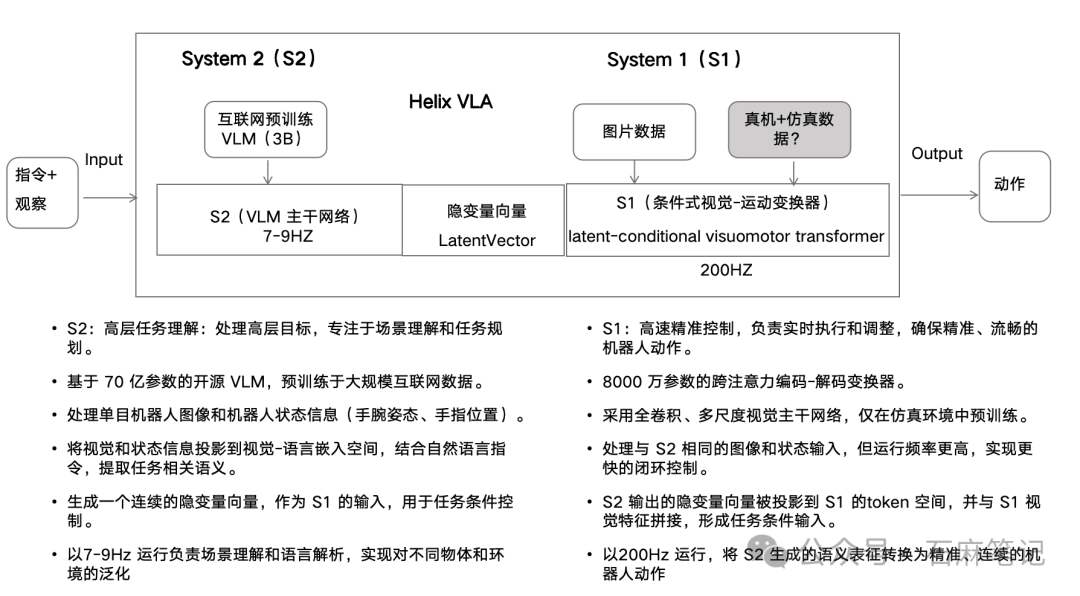
On this account, Helix's most distinctive feature is the separation of fast and slow thinking. Its architecture looks different from π0's, but there is a useful analogy between their roles. π0's action expert can be compared with Helix's S1, while the VLM's hidden token representations provide contextual information comparable in function to Helix's latent vector. In this conceptual mapping, Helix's S2 and S1 correspond to the pretrained VLM and action expert in π0. This is an analogy between functions, not a claim that the architectures or generation methods are identical.
Understanding the frequency difference between Helix's two systems
Figure reports S2 running at 7–9 Hz and S1 at 200 Hz, a substantial difference. Without separately scheduled systems, the overall model has a single inference cycle, even though the actions it generates can be executed at another rate. For comparison, π0 produces actions for 50 Hz control. Model inference frequency and action execution frequency need to be distinguished.
The comparison made in this interview treats π0 and Gemini Robotics as synchronous end-to-end systems, rather than Helix-style asynchronous dual systems. For many tasks, that arrangement may already be responsive and smooth enough. I still want to understand the practical benefit of asynchronous execution: how much does making S1 faster improve real applications? This is a question to investigate, not a definitive statement about every implementation of these models; in particular, the public details of Gemini Robotics do not establish every aspect of its runtime scheduling.
Before Figure announced Helix, the RoboDual work associated with AgiBot collaborators had explored an asynchronous dual-system architecture in October 2024. The recently released GO-1, discussed in Section 4, instead uses a synchronous pipeline; at this stage, its developers consider serial inference at roughly 5–10 Hz effective for manipulation foundation models. NVIDIA's GR00T N1, announced at GTC 2025, also separates S1 and S2, in a way conceptually similar to Helix. Different companies have therefore explored different arrangements at different times, and the choice is not settled. Editorial correction: the original says RoboDual preceded Helix by five months. RoboDual was submitted on October 10, 2024, and Helix was announced on February 20, 2025—approximately four months apart.
I used to be unclear about the relationship between frequency and runtime myself. To make the discussion easier to follow, here is the conversion: frequency and period are reciprocals.
Frequency, f: the number of repetitions of a periodic event per unit time, measured in hertz, where 1 Hz = 1/s.
Period, T: the time needed to complete one cycle, measured in seconds.
If an event occurs once every second, its frequency is 1 Hz. If it occurs once every 20 milliseconds, or 0.02 seconds, its frequency is 50 Hz.
The π0 inference time quoted in this discussion is around 80–100 milliseconds per pass, corresponding to roughly 10–12.5 Hz—1/0.1 = 10. This is close in order of magnitude to Helix's S2 at 7–9 Hz. The discussion quotes approximately 200 milliseconds, or 5 Hz, for end-to-end Gemini Robotics inference. These figures place π0, Gemini Robotics and Helix's S2 in a similar broad range. They are the timings used in this comparison, not hardware-independent performance guarantees.
A model that runs inference at around 5–10 Hz can nevertheless generate actions to be executed at a higher frequency, such as 50 Hz. Even if one inference pass takes 200 milliseconds, it can predict a sequence of controls for a future interval, such as the next two seconds. That sequence supports higher-frequency action execution. Here, it is the complete policy's action output we are discussing; Helix's S2 itself supplies a semantic representation to S1 rather than directly issuing a 50 Hz motor-control sequence.
My question was: if a model's brain can already generate actions for 50 Hz execution, what problem does an additional, faster S1 solve? Perhaps Helix has identified particular difficulties, but in my view the published description did not explain them clearly. Editorial clarification: executing a precomputed chunk at 50 Hz is different from updating a policy with fresh observations at 200 Hz. Figure's explanation emphasizes that S1 keeps responding to new visual and robot-state information between slower S2 updates. The question of the practical benefit remains worth studying, but that feedback distinction matters.
Why can inference be slow while action execution is fast?
Suppose each inference pass predicts the next two seconds of motion. At one pass every 200 milliseconds, the model performs five passes per second: one second equals 5 × 200 milliseconds, so its inference frequency is 5 Hz. Each of those passes produces a trajectory covering a longer future interval.
In other words, each inference pass predicts an action sequence. Even with only 5 Hz inference, the robot can execute those predicted actions at 50 Hz.
Model inference frequency: if one pass takes 200 ms, or 0.2 seconds, continuous inference can run at 1/0.2 = 5 Hz. Action execution frequency: suppose a pass produces an action chunk with 50 frames representing the robot's next second of motion. Those frames can be sent to the robot every 20 ms, or 0.02 seconds, for control. Since 1/0.02 = 50 Hz, the action sequence runs at 50 Hz. Roughly speaking, one inference pass predicts 50 future control commands, which are executed within one second.
This introduces the concept of an action chunk. Action chunking, used in robot learning and reinforcement learning, treats a sequence of actions over a continuous time interval as a single unit, rather than predicting only one frame or step at a time. In step-wise control, the model outputs an instantaneous action at each step—for example, controlling a motor every 20 ms. With action chunking, it outputs several future timesteps together. The resulting chunk can be viewed as a short motion plan.
An action chunk typically contains a fixed-length sequence of action vectors. If the model predicts two seconds of motion at 50 frames per second, the chunk has 100 action frames. Depending on the model, actions can be represented as continuous values, such as joint angles, or discrete tokens, such as indices into an action dictionary.
Thus, a relatively low inference frequency can support a higher action execution frequency by predicting many future actions at once—for example, 100 frames over two seconds. My view in this discussion was that 50 Hz control is sufficient for many intended applications, and that increasing it to 200 Hz might look smoother without necessarily being essential. There may be additional observations that have not been shared. That is my assessment, not a universal requirement: the value of faster control depends on the task, and faster execution of an existing chunk should not be confused with faster updates from new sensory feedback.
Why does Helix's S1 run faster?
Using S1 and S2 as a conceptual analogy, π0 processes the VLM context and action generation within one inference pipeline: the next full cycle follows the previous one. Helix instead combines dependency with concurrent execution. Its S1 is a smaller, roughly 80-million-parameter model that can run independently at 200 Hz. It depends on information from S2, which is the serial aspect, but does not need to wait for a new S2 result before every action, which is the parallel aspect. It uses the latest available semantic representation while continuing to process current observations. Keeping S1 small makes this efficient. Helix consequently updates its action policy at 200 Hz, whereas π0's generated actions are associated with 50 Hz control. Again, π0's VLM and action expert are not literally separately scheduled Helix-style S2 and S1 systems.
S1 plays the role of an action-generating policy, using a latent-conditioned visuomotor Transformer. Crucially, it also receives current visual information, rather than relying only on the semantic latent vector. That fresh image input enables closed-loop control while S1 runs independently between S2 updates. Editorial correction: the original describes S1 as denoising actions through diffusion. Figure describes Helix's S1 as trained with a standard regression loss; it should not be equated with π0's flow-matching action expert.
4. AgiBot's ViLLA architecture
AgiBot's published materials introduce Vision-Language-Latent-Action, or ViLLA, to make better use of high-quality AgiBot World demonstrations and large-scale heterogeneous internet video, improving policy generalization. GO-1 is a generalist embodied foundation model built on this architecture. Compared with a VLA, ViLLA predicts latent action tokens as an intermediate bridge between image–text inputs and the robot's executable actions. AgiBot reports strong performance on real-world dexterous manipulation and long-horizon tasks, substantially outperforming the open-source baselines evaluated in its study. That comparison concerns the reported evaluation, not every model or task.
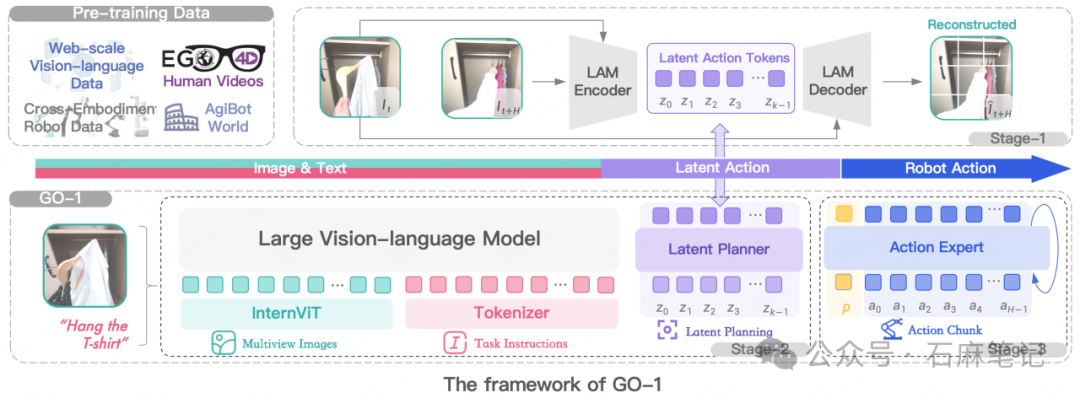
As explained in the interview, ViLLA combines a VLM with specialized expert modules, described here as a mixture of experts, or MoE. It uses InternVL2.5-2B as its VLM backbone to support general scene perception and instruction understanding. The interview describes multimodal information including multiview images, force-related signals and language. The latent planner uses intermediate VLM representations to predict latent action tokens, forming what the interview calls a Chain of Planning, or CoP. The action expert uses the VLM context and latent action information to produce the final fine-grained action sequence. At inference, the VLM, latent planner and action expert work together. Editorial clarification: the released paper explicitly specifies images and language for the planner and proprioceptive state for action generation; it does not establish force signals as a separate VLM input. Its two expert modules should also not automatically be read as a conventional sparsely routed MoE.
The latent action model, or LAM, learns general action representations from large-scale video data, such as human videos in Ego4D, and quantizes them into discrete latent action tokens. The latent planner reasons over time by predicting those latent actions, linking the image–text inputs to the robot actions generated by the action expert.
It is worth noting the parallel with NVIDIA Isaac GR00T N1, announced at GTC: the original discussion compares its training recipe with GO-1's three-stage approach, including a latent-action stage, and states that 80% of its real-robot data came from AgiBot's open million-trajectory AgiBot World dataset. Editorial clarification: GR00T N1 does use latent-action learning from video, but its training recipe is not identical to GO-1's. NVIDIA's original paper states that it used the 140,000 AgiBot-Alpha trajectories available when training began, alongside other real-robot datasets. It does not identify 80% as a universal share of all its real-robot training data; the original percentage lacks a specified counting or sampling basis and should not be treated as independently established.
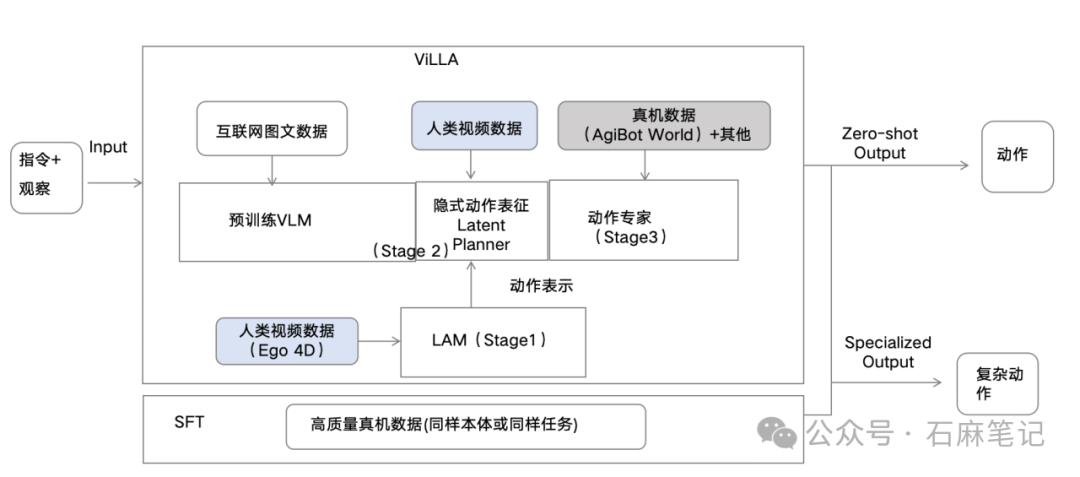
To make the comparison with π0 more intuitive, I abstracted ViLLA's architecture into the diagram above. Looking only at Stages 2 and 3, the main difference emphasized here is the intermediate latent planner. Stage 1, the LAM, provides the latent action representations needed to train that planner.
Why add a LAM in the middle? Robot data is scarce, especially real-robot imitation learning data. We wanted to explore whether human video could help address that shortage. Before robot imitation training, the model can learn from videos of people manipulating objects, using future-frame prediction and reconstruction to learn about the changes produced by actions.
Suppose we want to teach a robot to flip an egg in a pan. At the level of the manipulation being performed, that resembles a person reaching for a spatula and flipping the egg, even though human and robot control coordinates differ. We first use human video to teach predictive representations: when someone is about to flip an egg, the model learns about how the egg will change in subsequent frames. The idea is to learn this implicit latent-action capability before training on the robot's own actions.
When the model subsequently learns from robot imitation data, that prior understanding can help it grasp more quickly how the robot should act to flip the egg. The direction of action planning in latent space is clearer, potentially accelerating robot learning.
The semantics of these changes are compressed into latent action tokens. Predicting those tokens gives the model a representation of how an action is likely to change the scene. The LAM's decoder handles the reconstruction component.
To improve success on particular tasks, GO-1 also undergoes post-training. The paper calls this supervised fine-tuning, or SFT. It serves a similar purpose to π0's post-training stage.
The following video demonstrates GO-1's autonomous inference.
Using AgiBot's GO-1 embodied foundation model together with ADC, the adversarial data collection approach, this demonstration shows autonomous inference in a water-pouring task. The robot follows and moves toward the kettle, then grips its handle steadily. It quickly locates and continuously tracks cups of different types and colors. Its pouring motion is smooth, and the demonstration presents it as recognizing the water level in the cup to avoid overflow, aiming for efficient, safe operation. #EmbodiedAI #EmbodiedFoundationModels #AgiBot. Watch in the original WeChat article.
5. Some thoughts on approaches to general-purpose manipulation
There are at least four or five approaches to general-purpose manipulation. One is the large-scale, end-to-end imitation learning route exemplified by π0. Another is the hierarchical route, discussed in Conversation with Yunzhu Li: A New Approach to General-Purpose Manipulation through Learned Dynamics and VoxPoser & ReKep: Exploring Zero-Shot Robot Task Generalization through Task Representations. There are also approaches involving world models and simulation with sim-to-real transfer. I look forward to seeing more startups make progress along routes beyond end-to-end imitation learning.
Over lunch recently, a leader from a mobile internet company said something I expect to remember for years: 'The people who will eventually win are probably already in the arena.' In a field with a long horizon, I want to look past the noise, settle down, follow particular people and their work, and keep building my understanding. All that preparation is about recognizing the person who will ultimately succeed when I meet them.
References
π0
https://www.physicalintelligence.company/blog/pi0
Helix
https://www.figure.ai/news/helix
GO-1
https://agibot-world.com/blog/agibot_go1.pdf RoboDual https://arxiv.org/pdf/2410.08001