Simulation is a frequently encountered word in AI robotics: sim plus RL, sim-to-real, real-to-sim-to-real, and so on. It is essential not only to learning-based approaches, but also to model-based ones. Compared with debugging directly on hardware, testing algorithms in simulation before deploying them to a real robot can reduce risk and accelerate development. Some robots are also expensive and demand elaborate physical setups, so researchers prefer lower-cost ways to train them. These factors have made simulators widely used. Passing simulation tests, of course, does not by itself establish that real-world deployment will be safe.
While researching robot simulators, I discovered Simulately, an open-source resource initiated by young AI and robotics researchers. I personally think of it as a kind of Hugging Face for robot simulation. Although the project is still at an early stage in this account, it has helped me enormously as someone who initially found the simulator landscape bewildering. I was also fortunate to interview two contributors, Yuzhe Qin and Haoran Geng, who answered many of my beginner's questions. I have organized some of those discussions to give readers a more intuitive understanding of robot simulation.
Because there is a lot to cover, this Let's Talk About Sim series has two parts. The first introduces commonly used robot simulators. The second presents my questions about embodied AI simulation and my interview with Simulately contributors Yuzhe Qin and Haoran Geng. This overview reflects the ecosystem described in January 2024, with explicit corrections where the original contains an error.
Original article outline
Contents
↓
General-purpose simulators
Physics engines
Simulators for household environments
Specialized simulators
1. General-purpose simulators
A robot simulator lets researchers test algorithms without physical hardware. Two major components shape its performance: the physics engine and the rendering engine. The physics engine approximates physical systems, using algorithms to represent the laws of kinematics and dynamics and the mathematics of motion, collisions and interaction. The renderer provides visualization and affects visual realism and the quality of simulated visual sensors. Early robot simulators could consist mainly of a physics engine. More recent general-purpose systems combine physics with rendering, sensor support, reinforcement-learning interfaces and other capabilities.
Game engines are close relatives of robot simulators. With no single unified robotics simulator, researchers in areas such as drones and autonomous driving also build environments on game engines. Broadly, the ecosystem includes three types: simulation software developed by robot manufacturers such as ABB, KUKA and FANUC, usually serving their own products; third-party platforms from companies such as NVIDIA, including Isaac Sim; and open-source platforms such as Gazebo, Webots and SAPIEN. Academic groups and startups generally choose the latter two categories. These categories describe providers and ecosystems rather than mutually exclusive software licenses.
Isaac Sim
NVIDIA Isaac Sim is an extensible robot simulator that provides virtual environments for designing, testing and training AI-based robotic systems. Built on Omniverse, it emphasizes extensibility, realistic scenes and physical simulation. It combines PhysX physics, RTX rendering and Pixar's Universal Scene Description, USD, for describing robots and complex scenes. USD originated in animation and film production, while RTX real-time ray tracing is also used in games and visual effects. PhysX has been used by game engines including Unity and older Unreal Engine versions. To me, bringing PhysX, RTX and USD together gave Isaac Sim an overwhelming technological advantage in robotics simulation. Editorial clarification: USD is a scene-description framework, not itself a renderer; Unreal Engine 5 uses Chaos rather than PhysX as its default physics system.
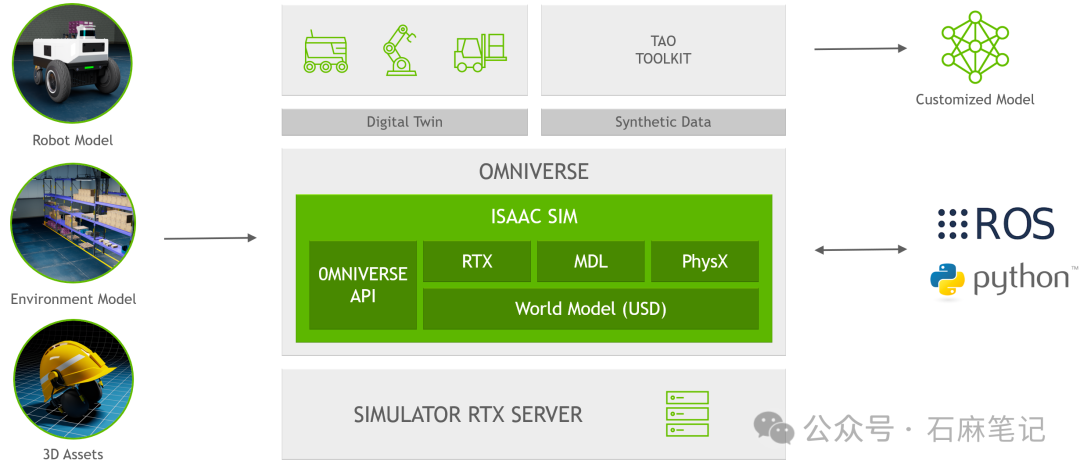
NVIDIA's standalone Isaac Gym preview moved major parts of physics simulation and the learning pipeline from CPU to GPU, making very large speedups—on some workloads, hundreds of times—possible. It was designed especially for reinforcement learning and became widely used in robot training, particularly quadruped RL. Both Isaac Sim and Isaac Gym use PhysX. At the time of this overview, I understood NVIDIA's resources to be moving toward Isaac Sim, and expected the older experimental standalone Gym to fade as its capabilities migrated into the broader platform. Editorial correction: the original dates this standalone preview to 2017, but NVIDIA announced it in December 2020. Describing Gym as simply merged into Sim obscures their separate packages; subsequent RL frameworks moved toward Isaac Lab. Speedups depend on the workload and comparison.
Introduction to Isaac Sim
Webots
Webots provides a complete robot development and modeling environment for industrial and academic research. Cyberbotics Ltd., an EPFL spin-off in Switzerland, began developing and commercializing it in 1998; its research origins at EPFL go back to 1996. Webots later moved from commercial software to an open-source model, while Cyberbotics continued developing and maintaining it. Its physics engine is based on ODE. The open-source release was in December 2018.
Introduction to Webots
CoppeliaSim
CoppeliaSim, formerly V-REP, is used in industry, education and academic research and offers commercial products as well as educational access. The original traces V-REP to research involving Toshiba in Japan and a 2010 publication. It was renamed CoppeliaSim in 2019 and is developed and maintained by Coppelia Robotics in Zurich, Switzerland. Its kinematics tools handle forward and inverse kinematics, and it supports multiple rigid-body physics backends, including MuJoCo, Bullet, ODE, Vortex and Newton Dynamics, depending on version. The 2010 V-REP paper credits Marc Freese, Surya Singh, Fumio Ozaki and Nobuto Matsuhira; its origin is more nuanced than describing it solely as a Toshiba product.
Gazebo
Gazebo is an open-source robot simulator developed initially in 2002 by Andrew Howard and Nate Koenig at USC's Robotics Research Lab, complementing the two-dimensional Stage simulator with three-dimensional simulation. It became integrated with the ROS ecosystem around 2009. The original dates a split in development to 2017: Gazebo Classic retains the older monolithic architecture, while modern Gazebo evolved into loosely coupled libraries. Classic can use physics engines such as ODE, Bullet and DART, with ODE as its default. Editorial clarification: modern Gazebo developed through the Ignition project; the names and architecture changed over several years, rather than through a single instantaneous split.
Thanks to the ROS ecosystem, I describe Gazebo as the most widely used robot simulator in this January 2024 overview. It also supported major robotics competitions, including the DARPA Robotics Challenge, DRC, in 2012–2015; NASA's Space Robotics Challenge, SRC, in 2016–2017; and the DARPA Subterranean Challenge, SubT, in 2018–2021. This is the historical competition landscape discussed in the original article.
Gazebo general-purpose simulator: DARPA Subterranean Challenge demonstration (watch in the original WeChat article)
DARPA Subterranean Challenge, SubT
PyBullet
PyBullet is an open-source, Python-oriented interface built on the Bullet physics engine and widely used in reinforcement learning. I regard it as a strong competitor to Gazebo. They serve overlapping needs but differ in scope and integration, so this is not a claim that they are identical platforms.
Autonomous-driving and drone researchers also use Unity and Unreal Engine to build simulation environments with realistic visual sensor outputs. MATLAB provides robotics tools and ROS integration as well. Editorial clarification: MathWorks' Robotics System Toolbox is distinct from Peter Corke's Robotics Toolbox for MATLAB, despite the similar names used in the original. ROS integration is also provided through MathWorks' ROS Toolbox.
2. Physics engines
A physics engine is software that approximates physical behavior, such as rigid-body dynamics and collision detection, deformable-body dynamics, or fluid dynamics. These engines are widely used in computer graphics, robotics, video games and computer-generated film imagery. In robotics, they simulate robot motion, collisions and interactions in a virtual environment. At its core, a physics engine is a large computational tool performing the mathematics needed to approximate physical systems.
Common engines in robotics include NVIDIA PhysX, used by both Isaac Sim and Isaac Gym, as well as MuJoCo, Bullet, ODE, RaiSim and DART. Vortex, Havok and Simbody are other engines encountered in robotics, games and related simulation applications.
PhysX
PhysX is NVIDIA's real-time physics middleware SDK, historically part of its GameWorks software suite. Its capabilities, depending on version and configuration, include rigid bodies, deformable bodies, joints, vehicles and fluids. It is a well-known engine in games and robotics. In robotics it powers Isaac Sim, Isaac Gym and simulators such as SAPIEN. In games, Unity, earlier Unreal Engine versions and various proprietary engines have used PhysX. Although earlier versions used simplified physical models, PhysX 5 expanded simulation capabilities and performance. The original also notes NVIDIA's recruitment of Bullet creator Erwin Coumans to work on physics simulation, dating it to 2021. Editorial note: the later Bullet section gives a different transition date, so the exact year is not established by this article. Unreal Engine 5's default is Chaos, not PhysX.
NVIDIA PhysX: rigid-body demonstration (watch in the original WeChat article)
Rigid bodies
NVIDIA PhysX: deformable-body demonstration (watch in the original WeChat article)
Deformable objects
NVIDIA PhysX: articulated-body demonstration (watch in the original WeChat article)
Articulated objects
PhysX originated in the NovodeX physics engine, developed by Swiss company NovodeX AG, an ETH Zurich spin-off. Ageia acquired NovodeX AG in 2004 and developed hardware to accelerate physics calculations alongside the CPU. The SDK was renamed PhysX, and the accelerator cards were called physics processing units, or PPUs. NVIDIA acquired Ageia in 2008, brought PhysX acceleration to its GeForce graphics cards, and eventually discontinued support for Ageia's PPUs.
MuJoCo
MuJoCo stands for Multi-Joint dynamics with Contact. It is a physics engine designed for robotics, including model-based control. Emo Todorov and collaborators introduced it in a 2012 paper; Todorov was then associated with the University of Washington's Movement Control Laboratory. The original describes commercialization through Roboti LLC in 2015. DeepMind acquired it in 2021 and made it freely available, then completed open-sourcing the code in May 2022. By the time of this overview, it supported robot research as an open-source project. The original's 2015 reference should not be read as dating the 2012 research paper or the 2022 open-source release.
Unlike many simulators designed primarily for games or film, MuJoCo is oriented toward robotics and seeks to avoid shortcuts that prioritize apparent stability over physical fidelity. For example, it includes gyroscopic effects in the equations of motion. It also supports musculoskeletal models of humans and animals, allowing modeled muscle forces to act through their appropriate moment arms and joints. MuJoCo is a prominent engine using generalized coordinates to represent articulated rigid-body systems, which is advantageous for long kinematic chains.
MuJoCo physics engine: quadruped demonstration (watch in the original WeChat article)
Quadruped model predictive control in MuJoCo
Bullet
Bullet, created by Erwin Coumans, provides collision detection and rigid- and deformable-body dynamics. It has been used in video games and film visual effects, and Coumans received an Academy Scientific and Technical Award for his work on it. The original describes his career as Sony Computer Entertainment's US research division in 2003–2010, AMD in 2010–2014, Google in 2014–2022, and subsequently NVIDIA. Bullet is free, open-source software with substantial roots in games and graphics, alongside robotics applications. Editorial correction: the original dates Bullet's introduction to 2006, but Coumans' own release announcements document it in 2005. The employment dates here are the original's historical account; its NVIDIA transition dates conflict between sections and have not been independently established.
Bullet humanoid simulation
ODE
ODE, the Open Dynamics Engine, is an open-source physics engine released in 2001, with Russ Smith as its principal author. Its two main components are a rigid-body dynamics simulator and a collision detection engine. It is widely used in games and is also a common robotics simulation choice, including for mobile robot motion and simple grasping. The original points to limitations in applications such as its approximate friction model and insufficient support for joint damping. These are application-dependent assessments, not a statement that all versions lack damping mechanisms.
ODE
RaiSim
RaiSim is a physics engine developed by RaiSim Tech, a general-purpose multibody simulator focused on efficient rigid-body simulation and the accuracy and speed needed by robotic systems. It has been used in research involving ETH's well-known ANYmal quadruped. RaiSim Tech is an ETH Robotic Systems Lab spin-off developing cross-platform multibody physics tools for robotics and AI. The robot's name is ANYmal, correcting the original spelling 'ANYMALL'; this does not mean RaiSim is the only engine used in ANYmal research.
RaiSim physics engine: ETH demonstration (watch in the original WeChat article)
RaiSim physics
DART
DART, the Dynamic Animation and Robotics Toolkit, was developed by Georgia Tech's Graphics Lab and Humanoid Robotics Lab and released in 2012. It serves robotics and computer animation, combining multibody dynamics simulation with kinematics tools for control and motion planning. DART exposes internal quantities such as the mass matrix, Coriolis and centrifugal terms, transformation matrices and their derivatives. The original contrasts this with engines treated mainly as black boxes. It highlights DART's generalized-coordinate representation of articulated rigid-body systems and use of Featherstone's articulated-body algorithms for dynamics as sources of accuracy and stability.
DART physics engine: Atlas demonstration (watch in the original WeChat article)
Atlas physics simulation in DART
Havok
Havok Physics is a three-dimensional physics engine developed by the Irish company Havok, primarily for video games. It supports real-time rigid-body collision and dynamics simulation. Intel acquired Havok in September 2007, and Microsoft acquired it from Intel in October 2015.
3. Simulators for household environments
Alongside general-purpose simulators, academic robotics groups have long worked toward household assistants. Some simulators therefore focus on everyday human environments, particularly homes. They emphasize realistic environments and sensory outputs. Many use game engines such as Unity or Unreal Engine, though others use different backends. They are often developed by leading university labs and operated as open-source projects.
SAPIEN
SAPIEN is an open-source robot simulator developed and maintained by researchers including Hao Su's UCSD group and collaborators at Stanford and Simon Fraser University. It aims to simulate realistic everyday environments, includes a large articulated-object dataset, and supports a range of household tasks.
A scene in the SAPIEN simulator
The diagram below shows SAPIEN's architecture. On the left, the renderer uses custom shaders and scene information to generate outputs such as RGB-D images and segmentation masks. The middle contains the simulator engine, built around NVIDIA PhysX and interfaces including ROS control. On the right are the assets, including the large PartNet-Mobility dataset. The UCSD research team also introduced ManiSkill, a manipulation-skill challenge built on SAPIEN to evaluate generalizable robot agents capable of interacting with the three-dimensional world in human-like ways.
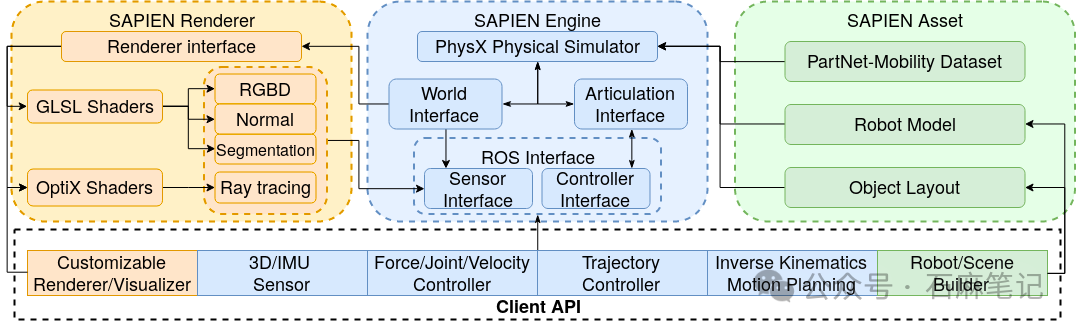
SAPIEN architecture
TDW
TDW, ThreeDWorld, is an open-source 3D simulation platform developed by researchers from the MIT–IBM Watson AI Lab, MIT's Department of Brain and Cognitive Sciences, Stanford and Harvard, including Chuang Gan. It has two components. The Build is a Unity-based application handling visual rendering, audio synthesis and physics. The Controller is an external Python interface that communicates with it. Researchers write controllers that send commands to the Build, which executes them and returns data describing the virtual world. Unity supports high-quality visual rendering, and TDW also offers high-fidelity audio and physical interactions involving materials such as cloth, liquids and deformable objects. Gan's group has also contributed specialized simulators such as RoboNinja for deformable-object manipulation, FluidLab for fluids and SoftZoo for soft robots. The platform's current source and documentation remain accessible through its official threedworld-mit/tdw repository; the historical website references below no longer reliably lead to the project.
Habitat
Habitat is an open-source platform from Meta FAIR for embodied AI research. Habitat 3.0 supports diverse, efficient simulation in household environments, including human–robot interaction and collaborative tasks. Its ecosystem includes Habitat-Sim, Habitat-Lab and the Habitat Challenge. Habitat-Sim is a high-performance 3D simulator with Bullet-based physics support. Editorial clarification: Habitat 3.0's human avatars and robot agents should not all be described as humanoid robots, as the original wording suggests.
AI2-THOR
AI2-THOR, The House Of inteRactions, is an open-source Unity-based simulator introduced by PRIOR, the computer vision research team at the Allen Institute for AI, Ai2. Its near-photorealistic indoor scenes support embodied agents learning household tasks. The iTHOR environment includes 120 rooms—kitchens, bedrooms, bathrooms and living rooms—with more than 2,000 distinct objects and physics support for objects and scenes. RoboTHOR provides simulated apartments with real-world counterparts: 89 simulated apartment layouts, more than 600 objects, and 14 physical apartment configurations, using a LoCoBot robot with a Kinect camera. The framework is open, and researchers can access the simulated environments and facilities for remote real-world evaluation. These are the dataset figures described in the original, not an inventory of every subsequent AI2-THOR environment.
Ai2 is a nonprofit research institute founded by the late philanthropist and Microsoft cofounder Paul G. Allen to carry out high-impact AI research and engineering for the common good. Allen cofounded Microsoft in 1975 and, according to the original account, donated more than US$2 billion over his lifetime. He established several nonprofit research institutions to advance important areas of health and technology. In 2003, he founded the Allen Institute for Brain Science to improve understanding of the brain in health and disease. The original subsequently dates Ai2 to 2013, while its introduction gives 2014; Ai2's own history states it was founded in 2014. The Allen Institute for Cell Science was established in 2014, followed by the Allen Institute for Immunology in 2018. Editorial correction: this English account uses Ai2's official 2014 founding date and identifies the original's contradictory 2013 date rather than silently repeating it.
WeChat Channels video: AI2-THOR
iGibson
iGibson, Interactive Gibson, is an open-source simulator from Stanford's Vision and Learning Lab, led by Fei-Fei Li. It combines Bullet physics with its own renderer. The version described here includes 15 high-quality, fully interactive scenes totaling 108 rooms, with rigid and articulated objects, alongside hundreds of larger 3D reconstructions of real homes and offices. Compatibility with CubiCasa5K and 3D-FRONT provides access to more than 12,000 additional interactive scenes. Researchers can use these environments to train and evaluate visually guided navigation and manipulation, such as opening doors, picking up and placing objects, or searching inside cabinets. Its predecessor was Gibson.
Stanford SVL researcher Roberto Martín-Martín summarized the different emphases of several household simulators. SAPIEN focuses on interaction with articulated objects such as doors, cabinets and drawers. TDW is multimodal, offering audio, high-quality visuals, and flexible-material and fluid simulation through NVIDIA FleX. His comparison notes that neither then included fully interactive scenes matching real object distributions and layouts as part of the environment. AI2-THOR includes interactive scenes, but many interactions are scripted: an object is annotated with available actions, and when an agent is close enough and the preconditions are satisfied, selecting an action transitions it to the prescribed state. RoboTHOR supports continuous interaction but focuses on navigation. iGibson emphasizes complex, long-horizon mobile manipulation, such as tidying a house or searching for objects, requiring comprehensive interaction within realistic large scenes. This is the comparison from his 2020 article, not a claim that later versions of these platforms retain every limitation.
Other household-environment simulators include MINOS and VirtualHome.
4. Specialized simulators
The general-purpose robot simulators and physics engines above have largely focused on rigid bodies. Many simulators for deformable objects and fluids have instead been developed by academic groups. Simulately categorizes these specialized tools, and I draw on its listing here. Readers interested in any of them can consult Simulately for individual introductions. These categories overlap: some general-purpose engines also support deformables or fluids.
Differentiable simulators: examples include DiffSim, FluidLab and DiSECt.
Deformable-body simulators: examples include SoftGym, FluidLab, RoboNinja and SoftMAC.
Fluid simulators: examples include FluidLab, FleX, Aquarium and Fish Gym.
Tactile simulators: examples include Taxim, DiffRedMax, TACTO and DiffTactile.
Soft-robot simulators: examples include SoftZoo and EvoGym.
This article gives a basic introduction to robot simulators. For a deeper discussion, see Let's Talk About Sim, Part II: An In-Depth Interview on Robot Simulation.
References
https://en.wikipedia.org/wiki/Physics_engine
https://en.wikipedia.org/wiki/Open_Dynamics_Engine
https://www.havok.com/havok-physics/
https://dartsim.github.io/gallery.html
https://dartsim.github.io/index.html
https://rsl.ethz.ch/partnership/spinoff/raisim.html
https://pybullet.org/wordpress/
https://en.wikipedia.org/wiki/Bullet_(software)
https://deepmind.google/discover/blog/open-sourcing-mujoco/
https://ieeexplore.ieee.org/document/6386109
https://homes.cs.washington.edu/~todorov/projects.html
Shuo Yang on Zhihu: https://zhuanlan.zhihu.com/p/545418917
https://developer.nvidia.com/isaac-sim
https://www.coppeliarobotics.com/
https://link.springer.com/chapter/10.1007/978-3-642-17319-6_8
https://en.wikipedia.org/wiki/Gazebo_simulator
https://staff.fnwi.uva.nl/a.visser/activities/robocup/Gazebo.pdf
https://pybullet.org/wordpress/
https://www.threedworld.org/ Historical TDW website; use the verified official repository and documentation: https://github.com/threedworld-mit/tdw
https://sapien.ucsd.edu/publication
https://arxiv.org/abs/2007.04954
https://www.threedworld.org/ Historical TDW website; use the verified official repository and documentation: https://github.com/threedworld-mit/tdw
https://arxiv.org/pdf/2007.04954.pdf
https://aihabitat.org/habitat3/
https://ai.meta.com/static-resource/habitat3
https://arxiv.org/abs/1712.05474
https://svl.stanford.edu/igibson/
https://svl.stanford.edu/igibson/1.0/docs/intro.html
http://gibsonenv.stanford.edu/
https://ai.stanford.edu/blog/igibson/