In Silicon Valley, there is a time machine for modern information technology: the Computer History Museum. Inside the museum is an exhibition on artificial intelligence and robotics. I spent several hours there recently, surrounded by robots created decades ago. What I saw astonished me. Across nearly a century of robotics research, robots with similar physical forms have appeared at different moments in history. Humanity has made so many attempts with the same kinds of robot bodies.
The shells of these robots reminded me of ourselves, returning to this world again and again. Scientists and dreamers in different eras have repeatedly tried to breathe a “soul” into them. Now, 105 years after the word “robot” was coined, we seem to have reached a tipping point in the story of humans and robots. In this latest attempt, it seems that robotic bodies and souls may finally be ready to share the Earth with us.
The series A Century of Robotics was inspired by the museum. Has the excitement we see today appeared before? How did today's robotics supply chain take shape? What have industry and academia explored in this field? Which ideas made it into the real world, and which did not? Why is today's progress in AI encouraging people to pursue general-purpose robots? History cannot tell us what the future holds, but it can help us distinguish breakthroughs that truly change a paradigm from old questions repackaged for a new era.
Let us look back at history, and forward to the future.
Part I: Science Fiction and Theater Carried Humanity's Imagination of the Future
1921: A Czech Playwright Introduces “Robot”
In 1921, Czech playwright Karel Čapek brought the word “robot” into public view in his play Rossum's Universal Robots, or R.U.R.
“Robot” comes from the Czech word robota, meaning forced labor or drudgery. In Čapek's story, humans manufacture an artificial form of life in factories to perform arduous work. From the very beginning, robots were created to work on humanity's behalf. But the story does not end well: these initially tireless, obedient “workers” eventually rebel and destroy humanity.
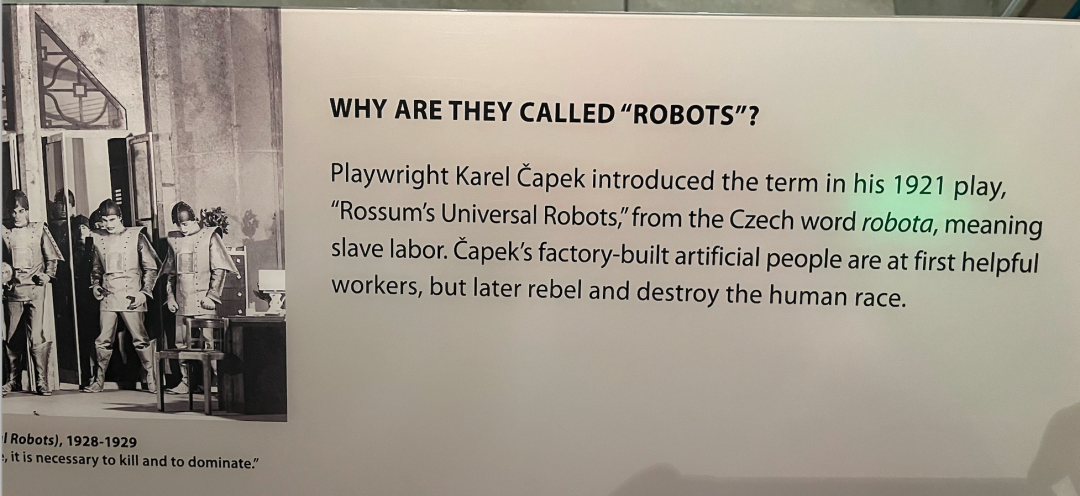
Interestingly, the history of robots begins with a story about machines and people, rather than a piece of technology. But the young Russian-born American science fiction writer Isaac Asimov did not like that story.
1942: Asimov Lays Down the Three Laws of Robotics
In 1939, at the age of 19, Asimov wrote his first robot story, “Robbie,” which was published in 1940. In his story, Robbie is not a monster waiting to awaken, but a loyal and dependable companion to a little girl as she grows up. Asimov began to seriously consider a question: if robots are designed and manufactured by humans, why could we not build the protection of, and obedience to, humans into their rules from the very start?
This idea eventually became the famous Three Laws of Robotics. In his 1942 story “Runaround,” Asimov first set out all three rules together: a robot must not harm a human; it must obey humans; and it must protect itself as long as doing so does not violate the first two laws. Over the following decades, he kept constructing new stories around these seemingly simple rules. What happens when the rules conflict? What happens when a machine receives an ambiguous human command? What happens when a sufficiently intelligent robot begins to understand the interests of society, or even humanity as a whole?
In 1950, these early stories were collected in I, Robot. Asimov went on to extend his robot stories further into the future, eventually even connecting the Robot series with his Foundation series.
Asimov's importance in robotics history goes beyond proposing the Three Laws. Before real robots had even entered factories, he had already moved the discussion from “Will robots destroy humanity?” to a more modern question: how should humans design a machine that is smarter than an ordinary machine and capable of acting autonomously?
History would soon step out of fiction and into reality.
Part II: There Are Always People Who Turn Imagination into Reality
1954: American Inventor Devol Brings Robots from Science Fiction into Reality
In 1954, American inventor George Devol proposed a “programmable mechanical arm,” which became one of the true starting points of modern robotics. He envisioned a machine that would no longer merely repeat movements dictated by a fixed mechanical structure. Instead, it could record a sequence of actions and then execute them automatically according to a program.
In 1956, George Devol and Joseph Engelberger met by chance at a cocktail party. Both were science fiction fans, and they soon began talking about the robots in Isaac Asimov's stories. That casual conversation about science fiction quickly turned into a discussion that would genuinely change the history of robotics.
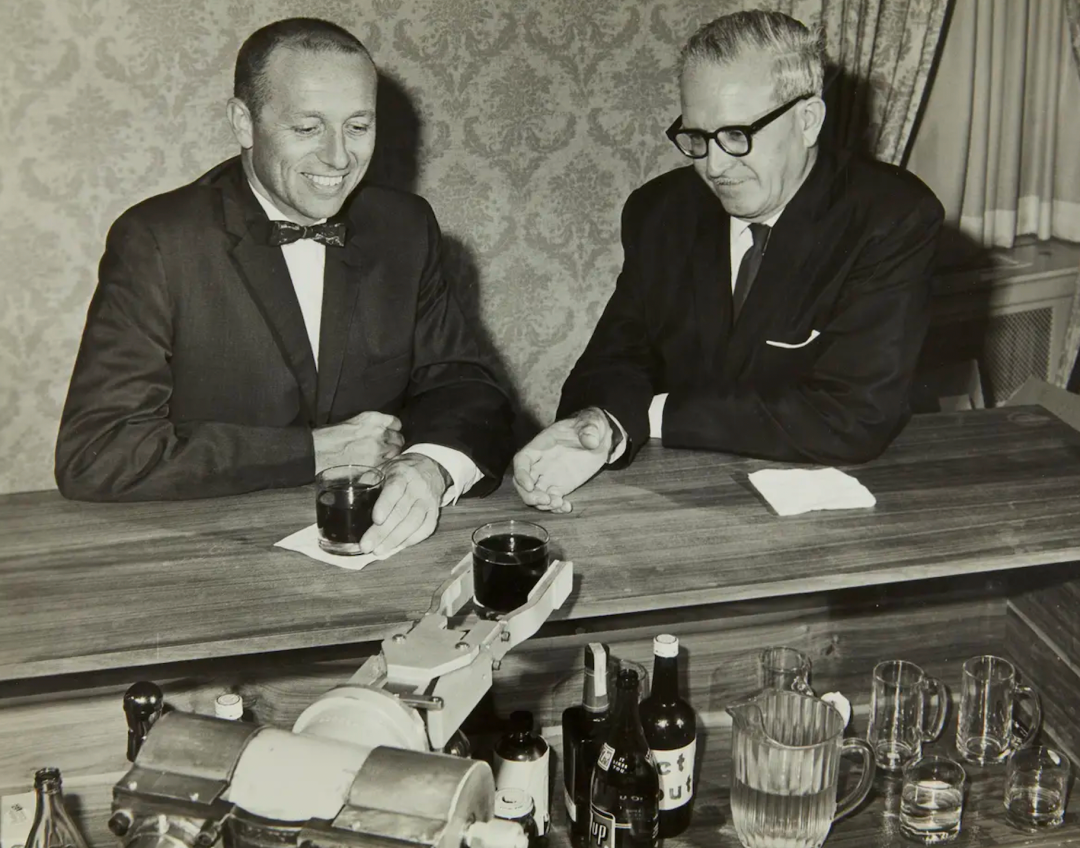
Devol had recently applied for a patent for his mechanical arm. He had the technology and the idea, but needed capital and a business partner. Engelberger happened to be an engineer who had been thinking about how more flexible machines could automate factories. One wanted to build machines; the other wanted to transform factories. They immediately hit it off. The story of modern industrial robotics began there. Their meeting ultimately led to Unimate, later known as the world's first industrial robot, its name meaning “Universal Working Mate.”
At the time, almost no off-the-shelf robot components were available. Early Unimate systems even used vacuum tubes for digital control before later switching to transistors. Encoders and memory devices were also immature, so the team had to design and manufacture many of the core components themselves, including a special magnetic drum memory system to record the robot's motion programs.
Although the original Unimate could already be “programmed,” it did not yet have a proper programming language. It used a very intuitive teaching method: an operator moved the arm to a specified position, and the machine recorded it; the operator then moved it to the next position, which was recorded in turn. Once a sequence of movements had been taught, Unimate could repeat them in the recorded order over and over again.
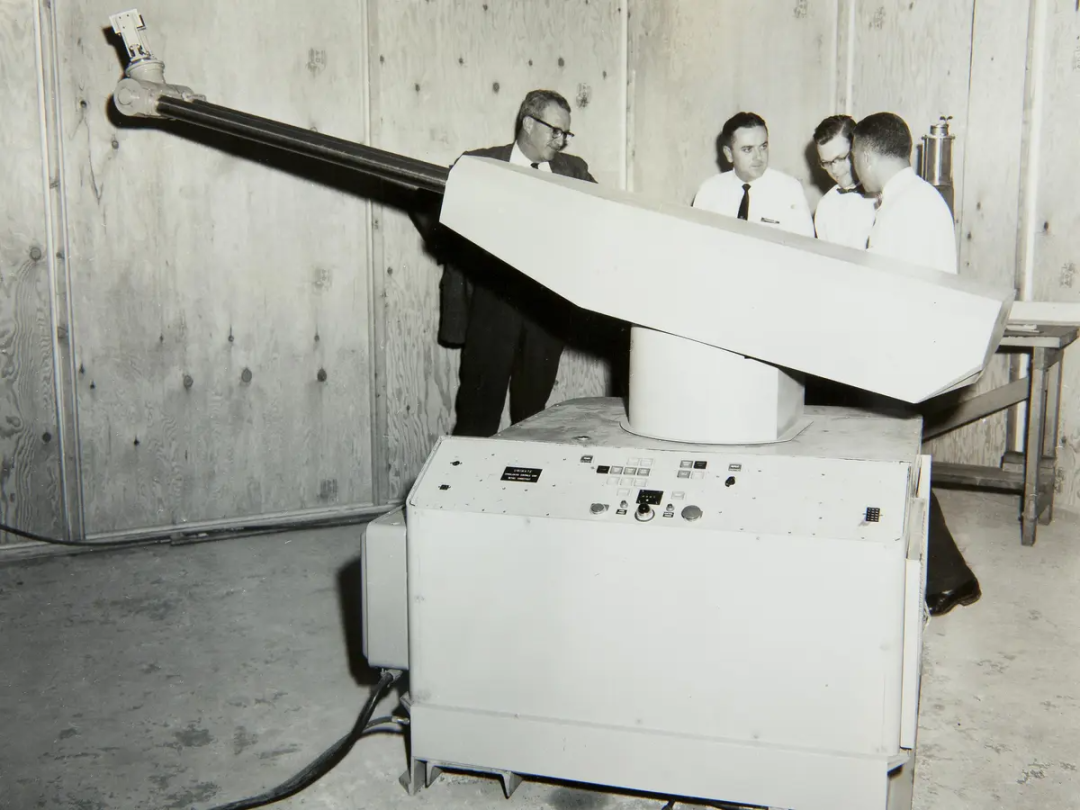
1961: Unimate Becomes the First Robot to Enter a Factory
In 1961, General Motors bought the first Unimate for $18,000 and installed it at its plant in New Jersey. Its first job was simple, but particularly well suited to a robot: removing hot metal parts from a die-casting machine and stacking them neatly. Robots subsequently began taking on other dangerous and repetitive jobs, including spot welding.
It was, however, a loss-making sale: manufacturing one Unimate cost as much as $65,000, against a selling price of $18,000. Engelberger was willing to sell it so cheaply because he knew that having GM as the first customer was the best possible advertisement. He also believed that more orders would soon follow. Unimate quickly attracted the attention of the automotive industry, and companies including Chrysler, Ford, and Fiat began purchasing robots. Industrial robotics grew from an invention into an industry.
By the early 1970s, Unimate's selling price had risen to $35,000. Even so, Unimation did not turn its first profit until 1975—19 years after the company was founded.
The first Unimate cost $65,000 to build and sold for just $18,000. It took industrial robotics nearly 20 years to go from its birth to a genuinely profitable business.
1970: The First Conflict over Robots in Factories
Initially, GM workers did not object to Unimate. Moving scorching metal out of a die-casting machine was, after all, dangerous work that nobody wanted to do. In 1967, GM installed two spot-welding robots at its Norwood plant in Ohio, again without much controversy.
At the Lordstown plant in 1970, GM deployed 28 spot-welding robots at once and began sharply increasing production efficiency. To produce the Chevrolet Vega, the plant laid off at least 700 employees and eliminated another 300–500 jobs deemed “too simple to require a person.” The production line accelerated from 60 to 101 cars per hour, an increase of 67%.
The faster assembly line came with longer working hours. Workers were required to work 11–12 hours a day, sometimes with weekend overtime. Tensions quickly erupted. Workers filed more than 16,000 grievances and then went on strike. In March 1972, a strike shut the entire plant down for 22 days.
Lordstown later became a classic case of automation's impact on workers. For the first time, robots were associated not just with doing dangerous work on people's behalf, but also with layoffs, faster production, and greater work intensity.
To some extent, the conflict also affected Unimation's image in the United States. Although industrial robots were born in America, they struggled to gain a real foothold in their home market.
The 1970s: Unimation Ignites Japan's Industrial Robotics Boom
Compared with the United States, Japan offered Unimate a bigger stage.
In 1966, Engelberger visited Japan and spent several hours speaking with hundreds of people from Japanese industry, hoping to find a partner to manufacture robots locally. Japanese companies showed tremendous interest. Kawasaki Aircraft, later part of Kawasaki Heavy Industries, was particularly enthusiastic and ultimately secured a technology license from Unimation. In 1968, Kawasaki established a dedicated department to localize industrial robot production. It then sent engineers to the United States for training and brought a prototype back to Japan as the basis for further development and domestic manufacturing.
In 1969, Japan's first domestically manufactured Kawasaki-Unimate 2000 was born. It was an enormous machine: weighing 1.6 metric tons and measuring approximately 1.6 × 1.2 × 1.3 meters, it could handle objects weighing just 12 kilograms. Its price was about $90,000, equivalent to roughly $595,000 in the original article’s present-day comparison. At the time, the average starting salary for a Japanese university graduate was only a little over $200 per month. The inflation comparison and contemporary graduate salary are estimates quoted by the original article, rather than newly calculated values.
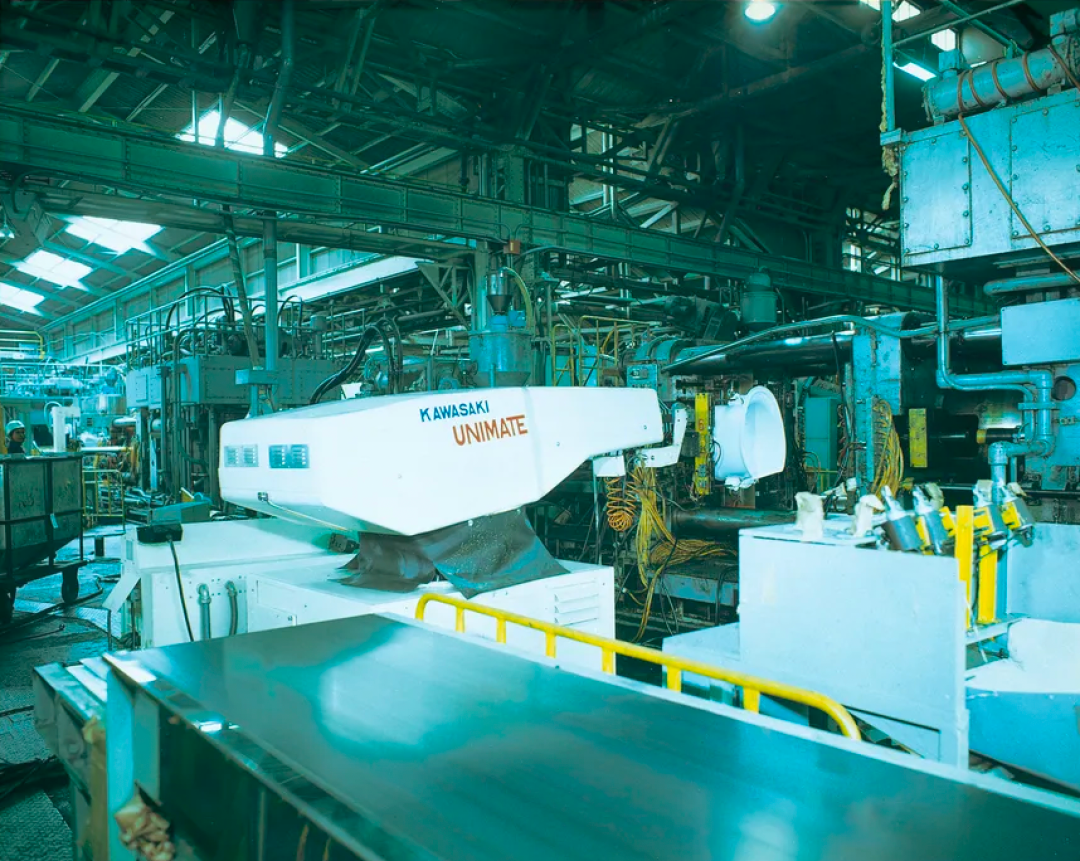
A robot born in America had crossed the Pacific and set off another, larger industrial robotics revolution in Japan. By the mid-1980s, Japan had become the “kingdom of robots,” with nearly 70% of the world's industrial robots.
Part III: The People Who Defined AI Created the First Robotics Laboratories
1961: At MIT, AI Reaches Out a Hand for the First Time
In the late 1950s, as Devol and Engelberger were trying to bring Unimate into factories, another group of people in MIT's laboratories began taking an interest in mechanical hands. Their concern was not automated production. It was a question more closely associated with AI: if a computer could truly possess intelligence, could it control a hand of its own and interact with the physical world?
The 1956 Dartmouth conference had only recently given the new field of “artificial intelligence” its name. A few years later, key figures from that conference began gathering at MIT. John McCarthy, who would later found Stanford's SAIL, arrived from Dartmouth in 1958. Marvin Minsky, who would later be a founding figure in the lineage of MIT's CSAIL, joined in 1959. Claude Shannon, the father of information theory, was already there. The people conducting some of the earliest research on robotic arms were themselves among the first to define artificial intelligence. [Historical note: Minsky joined MIT’s faculty in 1958; the AI laboratory was founded the following year. The original conflates those dates.]
In 1961, under the guidance of Claude Shannon and Marvin Minsky, MIT doctoral student Heinrich Ernst completed his dissertation, MH-1, A Computer-Operated Mechanical Hand. MH-1 became one of the earliest manipulators directly controlled by a computer.
But the real significance of MH-1 was not simply that “a computer could finally make a mechanical arm move.” Ernst wanted to know whether a mechanical hand could obtain information about the outside world through sensors, and whether a computer could then decide what movement to make next. In other words, he was already trying to establish a loop that would run through the entire history of robotics research: perceive the world → compute and decide → control the body → change the world.
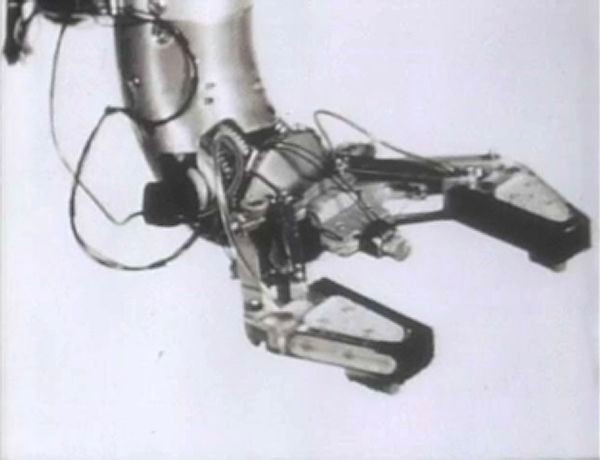
A few years later, John McCarthy left MIT for Stanford. This group of people studying how machines could think would carry the same question to the American West Coast. There, Bernard Roth, Donald Pieper, and Victor Scheinman would take it a step further: if a computer is going to control a hand, should we design a hand specifically for the computer from the outset?
1962–1963: John McCarthy Arrives at Stanford, and AI Begins Looking for a Body
In 1962, John McCarthy left MIT and returned to Stanford. He subsequently established the Stanford Artificial Intelligence Laboratory, the renowned SAIL. Stanford officially traces SAIL's founding to around 1963. By 1965, with the establishment of the Computer Science Department and improvements in funding and equipment, SAIL had become one of America's most important AI laboratories.
After arriving at Stanford, McCarthy wanted to continue working on robots. But there was a problem: the AI lab was full of computer scientists and mathematicians. Who was going to build the robot's body?
Stanford introduced McCarthy to Bernard Roth, a young professor in the Mechanical Engineering Department. Roth's academic background was not in AI, but in classical mechanism theory and kinematics. That background was precisely what made him an important founding figure in modern robotics. Before a computer could control a robotic arm, it needed to answer a seemingly simple question: if the end of the arm must reach a certain position in space, how far should each joint rotate? This became one of the fundamental problems in robotics: inverse kinematics.
Roth later recalled that Stanford was concerned that, although McCarthy was a great mathematician, he might not be the right person to take responsibility for mechanical systems. The university hoped Roth would fill that gap. Roth subsequently took on SAIL's work on robotic arms. Before joining Stanford's Mechanical Engineering Department in 1962, he had studied for his doctorate under Ferdinand Freudenstein at Columbia, working on mechanisms, linkages, and kinematics. One of the things this group of researchers was doing was turning mechanical problems previously solved through geometric constructions into mathematical problems that digital computers could calculate.
The combination of McCarthy and Roth brought together AI researchers who wanted computers to control machines and mechanical engineers who were beginning to translate machine motion into mathematics that computers could understand.
Robotics emerged precisely at the intersection of the two. In 1962, SAIL, a pioneering organization in robot learning, brought AI and robotics together. This cradle of AI and robotics gradually nurtured early explorers of the intersection, including Scheinman and Donald Pieper, who helped lay the foundations for robot learning. [The original’s 1962 date refers to McCarthy’s arrival; Stanford’s archives date SAIL’s founding to 1963, as noted above.]
1963: The Rancho Arm—Stanford Starts with an Existing Hand
Stanford did not initially build its own robotic arm from scratch. It acquired a Rancho Arm. This arm had originally been developed as an assistive device for people with disabilities, rather than for AI. Stanford connected it to a computer to study computer control. Around this time, the young Victor Scheinman joined Bernard Roth's team.
Scheinman showed engineering talent early. He entered MIT at 15 and earned a degree in aeronautics and astronautics in 1963. After graduation, he worked at Boeing on a lunar gravity simulator and also participated in work related to the Apollo command module's heat shield and Saturn rocket turbopumps. He later went to Stanford for further study, moving from aerospace into mechanical engineering.
Joining the Stanford AI Lab truly changed his life. There, as Bernard Roth's research assistant, he was tasked with studying how to “build hands and arms for computers.” The laboratory already had a Rancho Arm, but this arm, originally designed for people with disabilities, lacked precision and had difficult inverse kinematics. Scheinman subsequently tried a snake-like Orm Arm and a powerful hydraulic arm, but neither was easy to control. These failures gradually led him to a realization: instead of building a mechanical arm and then figuring out how a computer could control it, why not build a hand “born for the computer” from the outset?
1968: Donald Pieper First Solves the Arm's Mathematics
Bernard Roth's student Donald Pieper made the first major advance on this problem. In 1968, Pieper completed his dissertation, The Kinematics of Manipulators Under Computer Control. He systematically studied manipulator kinematics and demonstrated that certain special joint configurations could simplify the complex problem of inverse kinematics. One idea with a particularly lasting influence was to make several of the wrist's rotational axes intersect at a single point.
Today, calculating inverse kinematics is no great challenge for a computer. In the 1960s, the situation was entirely different. Computing power was extremely limited. The smartest approach was therefore not to build a complicated arm and use a more powerful computer to handle it, but to redesign the arm so that the mathematics itself became simpler. This helped establish the design philosophy behind many subsequent six-axis industrial robotic arms.
1969: Victor Scheinman Builds a Hand “Born for the Computer”
After Pieper addressed the mathematical problem, Victor Scheinman began turning the idea into a real mechanical arm.
In 1969, he designed the famous Stanford Arm. It was fully electric, had six degrees of freedom, and placed the wrist's three rotational axes so that they intersected at one point. This allowed even the limited computers of the time to calculate and control the arm's movement in space. Stanford later built the Gold Arm and the Blue Arm, combining the arms with vision to study hand–eye coordination and cooperation between two arms.
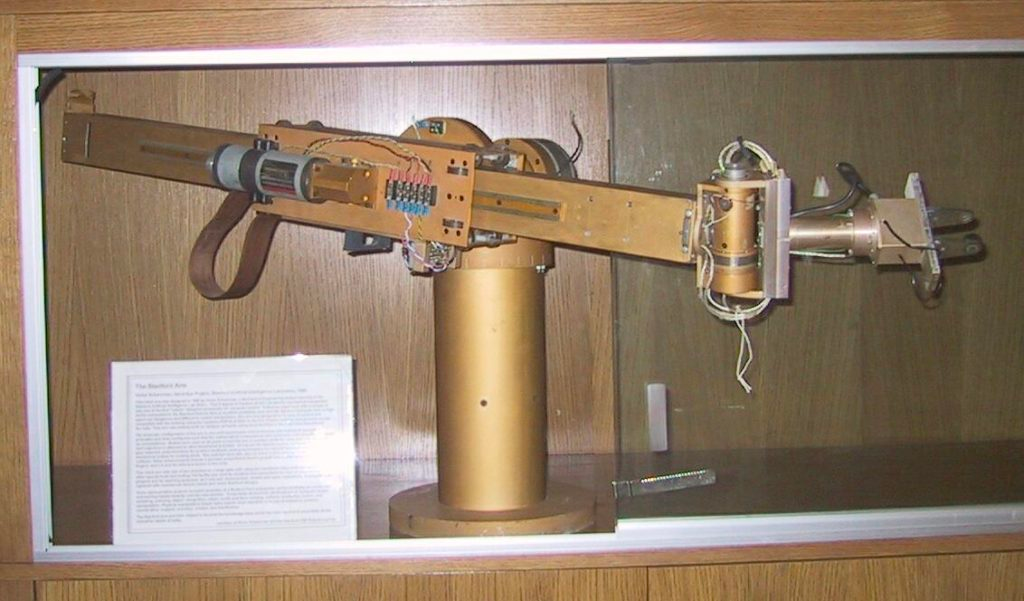
The Stanford Arm's greatest significance was therefore not that “another robotic arm had appeared.” The philosophy of robot design had changed. Previously, people built a machine and then tried to figure out how a computer could control it. With the Stanford Arm, mechanical structure, kinematics, and control systems began to be designed together. In the language most familiar to us in 2026, this was hardware–software system co-design.
Around 1972, at the invitation of AI pioneer Marvin Minsky, Scheinman returned to MIT to design a more compact MIT Arm. It used an all-revolute joint configuration, concealed wiring inside the arm, and employed specially designed gears to reduce backlash. Its form was now coming closer to the six-axis industrial arms familiar to us today.
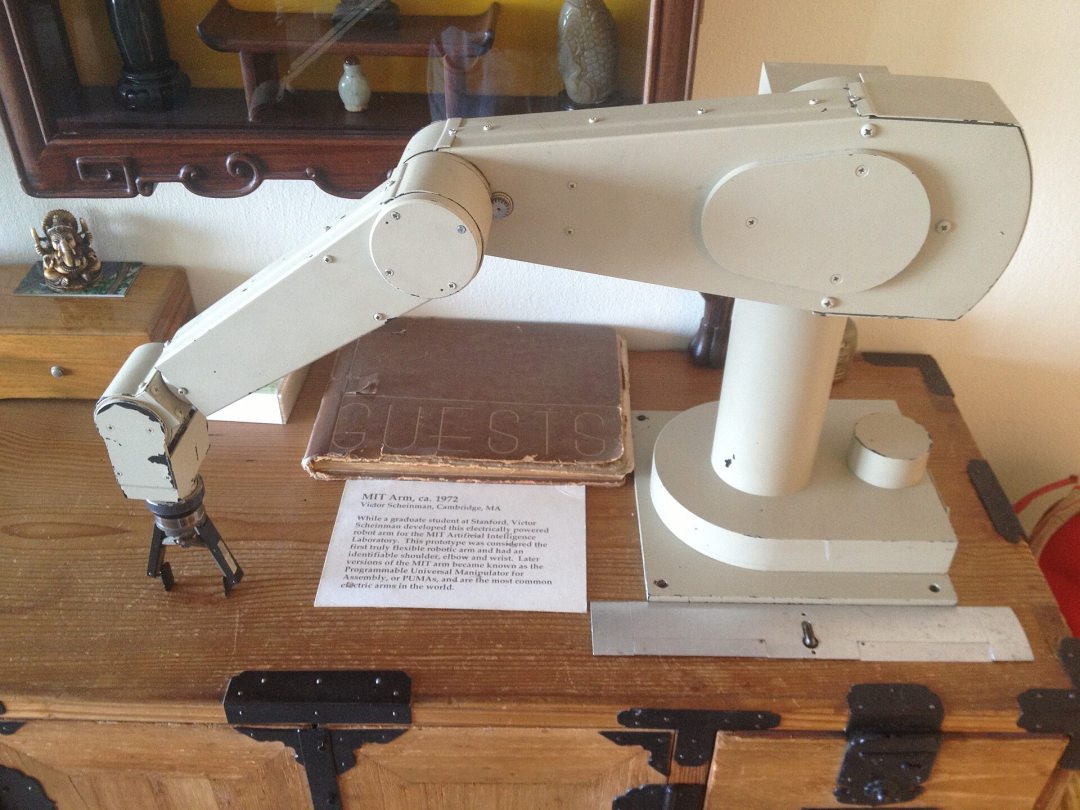
1973: Scheinman Founds Vicarm, and Academic Robotics Leaves the Laboratory
In 1973, Scheinman decided to turn the research accumulated at Stanford into a product and founded Vicarm. The Stanford Arm had originally been a research instrument. Vicarm began turning it into a complete robot system: an arm, servo systems, a controller, and a programming language. This included VAL, which would become an important robot programming language. Robots were gradually evolving from laboratory arms into genuinely programmable computer peripherals.
Interestingly, Scheinman's connection with Unimation had begun much earlier. While studying at Stanford, he had received a fellowship funded by Unimate inventor George Devol. He also accompanied Devol and Joseph Engelberger on visits to Unimation and its customers, seeing firsthand how early Unimate robots handled materials, loaded and unloaded machines, and welded. He also saw their limitations: these hydraulic robots mainly repeated movements by recording positions, and it was difficult to control the arm continuously along a trajectory.
Later, Scheinman carried a Vicarm straight into Engelberger's office, placed it on his desk, and demonstrated continuous-path control that Unimate could not achieve at the time. At one robotics exhibition, the organizers even dismissed Vicarm as a “toy” because it was so small. Scheinman simply set it up at the entrance to the exhibition hall, plugged it into an extension cord, and demonstrated it there. Instead, it drew a crowd of researchers who truly understood robotics.
The company that ultimately saw the potential of this “little arm” was GM. GM wanted to scale it up for automotive assembly, but worried that a small company like Vicarm would be unable to supply it in volume. It therefore encouraged Scheinman to find a larger partner. That partner turned out to be Unimation.
Part IV: The Academic and Industrial Paths Finally Converge
In 1977, two paths in robotics history that had developed for nearly two decades finally came together.
One came from industry. Since Devol and Engelberger created Unimate, the focus had been on a practical problem: how to get robots into factories to work on people's behalf. The other came from the laboratories of MIT and Stanford. From McCarthy and Minsky to Bernard Roth, Donald Pieper, and Victor Scheinman, these researchers were concerned with a different question: how could a computer truly understand and control a mechanical hand, moving it along a calculated trajectory?
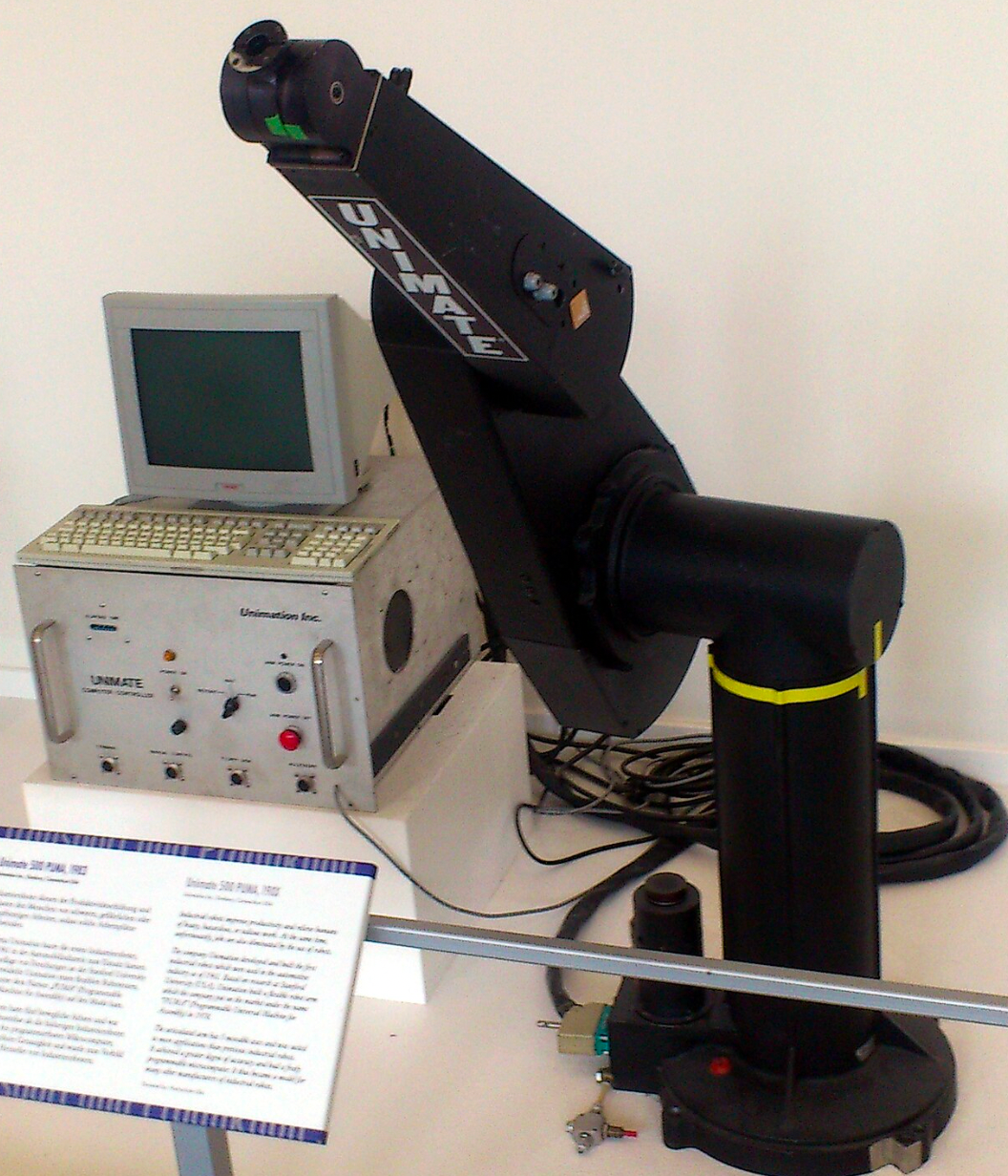
In 1977, Unimation acquired Victor Scheinman's Vicarm, and the two paths truly joined for the first time. With encouragement from GM, the technology that had originated in Stanford's laboratories continued to develop, eventually producing the famous PUMA arm: the Programmable Universal Machine for Assembly.
In 1980, Scheinman left Unimation and joined Automatix, where he continued developing new robot systems. Among them was the modular Robot World, which was later acquired by Yaskawa.
Starting in an AI laboratory, Scheinman spent nearly a decade thinking about how to build a genuinely useful hand for a computer. Starting in factories, Devol and Engelberger thought about how to make robots genuinely work on people's behalf. After nearly two decades, the paths converged. The laboratory's “hand” was fitted to the industrial robot's “body,” and PUMA was born.
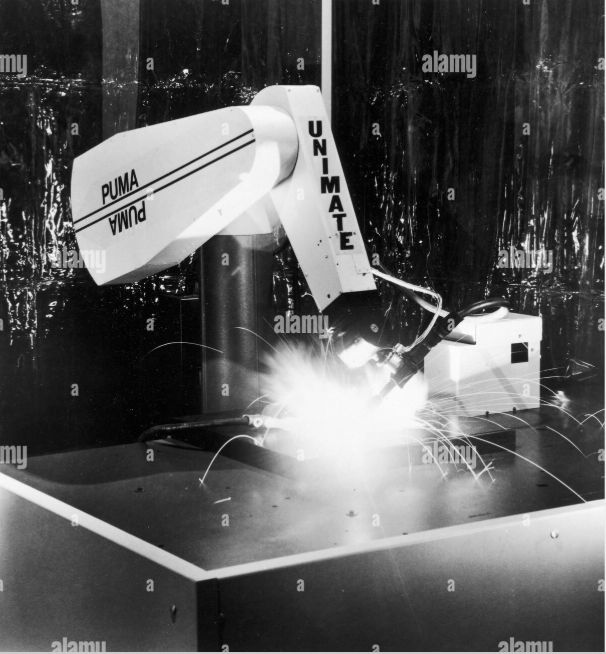
If Unimate represented the first commercialization of industrial robots, PUMA's greater significance was that it brought computer control, kinematics, and electrically driven arms developed in Stanford's laboratories into the industrial world. From the Stanford Arm to PUMA, the basic form of the modern industrial arm was becoming increasingly clear. From this moment onward, laboratory robots and factory robots were no longer two entirely different species.
In 1983, Unimation was sold to Westinghouse Electric for $107 million. Engelberger subsequently shifted his attention to medical and domestic service robots, while Devol gradually left the robotics field. The two later became known as the “father” and “grandfather” of industrial robotics, respectively. [The original names Western Electric; the acquiring company was Westinghouse.]
A chance encounter at a cocktail party in 1956 ultimately ignited a robotics revolution that swept through manufacturing around the world.
A Century of Robotics, Episode One: Closing Thoughts
In 1961, Unimate entered a GM factory. It represented industry's understanding of a robot: teach a machine human movements and have it repeat them without fatigue. At almost the same time, MIT's MH-1 represented a very different vision: instead of telling a machine exactly what to do at every step, let a computer perceive its environment and decide how its hand should move.
These two paths, both starting in 1961, would follow different destinies in the decades that followed. One led to industrial robotics. Machine “slaves” without “thoughts” replaced large amounts of human labor, achieved commercial viability in manufacturing, and helped a flourishing industrial automation supply chain emerge. The other led toward AI and robotics research. Humans wanted to give machines eyes, brains, and judgment of their own, allowing them to truly complete the loop from perception to action. More than six decades later, we are still on that journey.
We learned to build robotic bodies long ago, yet we have still not truly given them intelligence. This may be the most thought-provoking paradox in a century of robotics: the fact that machines have been so slow to acquire intelligence may be humanity's misfortune—or perhaps its good fortune. In 1921, Čapek had already written an ending in which robots awaken and rebel against humanity. In 1942, Asimov was already eager to constrain an intelligent life form that did not yet exist with three laws. Now, in 2026, we are finally investing unprecedented amounts of capital, computing power, and intellect in an attempt to fulfill a dream that has remained unfinished for more than six decades. We are so eager for robots to possess intelligence. Yet perhaps only on the day they truly acquire it will we understand why, a hundred years ago, humans had already begun to fear them.
To be continued.
References
https://en.wikipedia.org/wiki/Unimate
https://en.wikipedia.org/wiki/Unimation
https://www.computerhistory.org/revolution/artificial-intelligence-robotics/13/292/1271
https://spectrum.ieee.org/unimation-robot
https://robohub.org/farewell-to-vic-scheinman-inventor-of-the-modern-robot-arm/
https://people.csail.mit.edu/bkph/articles/Kinematics_Vicarm_WP_69.pdf
https://en.wikipedia.org/wiki/Victor_Scheinman
https://en.wikipedia.org/wiki/Stanford_arm
https://commons.wikimedia.org/wiki/File:Scheinman_MIT_Arm.agr.jpg
https://en.wikipedia.org/wiki/Programmable_Universal_Machine_for_Assembly
https://www.researchgate.net/figure/The-PUMA-robot-from-16_fig5_329590080
Unimation PUMA video: https://www.youtube.com/watch?v=64HWzpUysTs