My previous article, A Survey of Leading Legged-Robotics Teams, focused on teams with strong capabilities in robot hardware and control—the 'robotics camp.' This time, I will map the 'AI camp' in robotics, particularly teams using reinforcement learning, deep reinforcement learning, imitation learning, transfer learning and meta-learning to solve robot-learning and control problems. Editor’s note: This article is a September 2023 snapshot. Affiliations, student status, publication statistics and citation counts below refer to that period; it is not a directory of current appointments.
This distinction between the robotics and AI camps largely comes from successive approaches to humanoid software control. A useful, simplified division is into three generations: first, relatively simple model-based control, such as LIPM + ZMP, exemplified by ASIMO; second, dynamic-model and optimal-control methods, such as MPC + WBC, exemplified by Atlas; and third, simulation + reinforcement learning. Each approach has strengths and weaknesses, which I will not explore technically here. In terms of researchers’ backgrounds, the first two generations generally draw on control, automation and electrical engineering, while the third, sim + RL, often draws on computer-science researchers working in AI. This map of Chinese-origin AI + robotics researchers therefore emphasizes that third group, where AI intersects with robotics.
Original article outline
Contents
👇
1. UC Berkeley BAIR
2. Stanford SAIL
3. MIT CSAIL
4. CMU
5. UW & NVIDIA
6. UCSD
7. Other North American Universities and Companies
8. Tsinghua University
9. Peking University
10. Shanghai Jiao Tong University
11. Other Chinese Universities and Companies
1. UC Berkeley BAIR
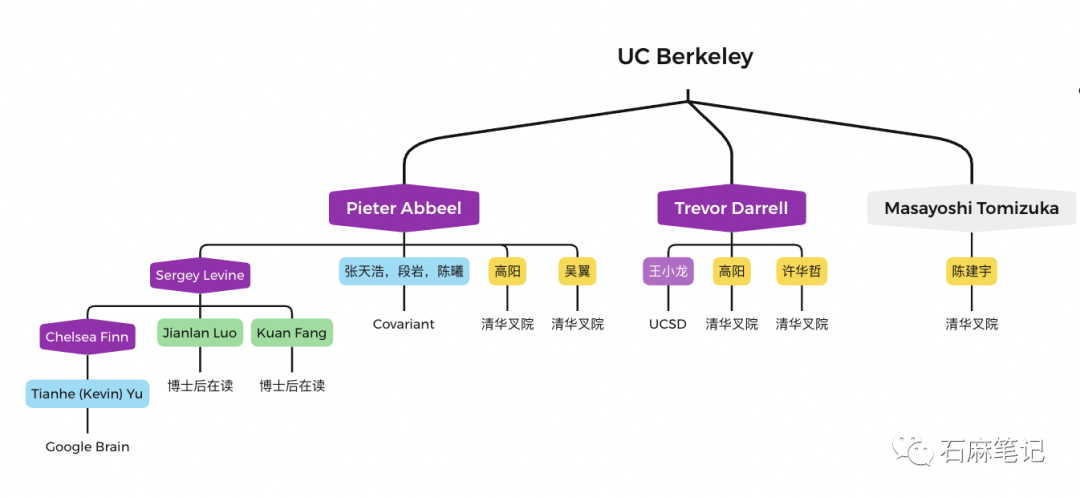
Highlight colors: purple—faculty positions outside China; green—current students; yellow—faculty positions in China; blue—industry.
Chinese-Origin Researchers in UC Berkeley’s Robot-Learning Network
In my view, UC Berkeley towers over the robot-learning field, or AI + robotics more broadly. I saw a remark on Zhihu suggesting that other universities’ strength depends, to a surprising extent, on their geographical distance from Berkeley. The statistics on authors of accepted CoRL papers shown below seem to bear that out: UC Berkeley ranks first, Stanford second and UW third. These are the statistics used in the original article, rather than an all-time ranking.
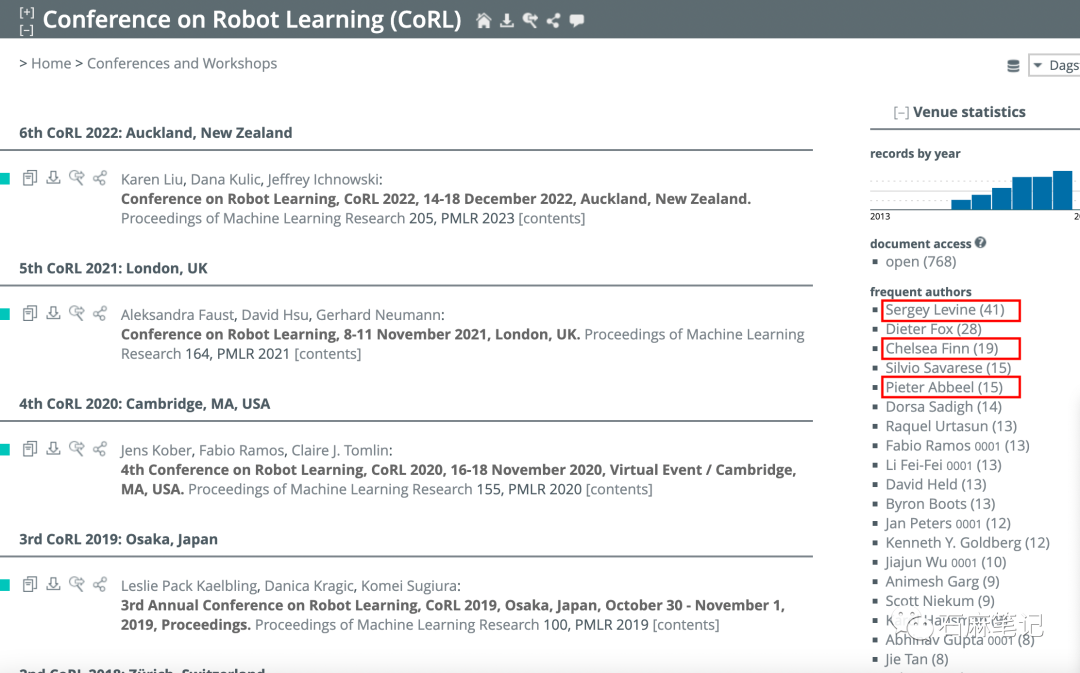
Author Statistics for Papers at the Conference on Robot Learning (CoRL)
Within UC Berkeley’s AI + robotics community, I see Pieter Abbeel’s research lineage as the strongest. A pioneer in applying deep reinforcement learning to robotics, he received the 2021 ACM Prize in Computing. ACM’s award announcement credited his pioneering work in teaching robots to learn from human demonstrations through imitation learning and from their own trial and error through reinforcement learning, laying foundations for the next generation of robotics. In Covariant: An AI-for-Robotics Unicorn Founded by Three Chinese Researchers, I introduced Abbeel and the AI + robotics unicorn Covariant, which he founded with three Chinese students: Tianhao Zhang, Yan Duan and Xi Chen. Abbeel and his team were also major participants in OpenAI’s earlier embodied-intelligence program, which OpenAI subsequently paused. Editor’s note: '2021' is the award year; ACM announced the prize in 2022.
Pieter Abbeel is a professor of electrical engineering and computer sciences at UC Berkeley, co-director of Berkeley Artificial Intelligence Research (BAIR) and director of the Berkeley Robot Learning Lab. He is best known for his work at the frontier of robotics and machine learning, especially deep reinforcement learning. He received bachelor’s and master’s degrees in electrical engineering from KU Leuven in Belgium in 2000 and a PhD in computer science from Stanford. He was Andrew Ng’s first PhD student. One interesting connection is that Ng’s own dissertation was in reinforcement learning, although his later work moved toward other areas. Abbeel carried that RL tradition forward and, in my assessment, built one of today’s strongest RL + robotics research lineages.
Abbeel’s influence through mentorship spreads throughout AI + robotics. One researcher he mentored, Sergey Levine, has been exceptionally prolific at leading robot-learning conferences, contributing to 41 CoRL papers in the statistics I consulted—far ahead of other researchers. Levine in turn helped train another leading researcher, Chelsea Finn, now a Stanford professor. Judging by paper output, Abbeel, Levine, Finn and the researchers they have trained might account for something like half the field. This is my impression of their influence, rather than a measured market share. Their academic descendants are found at major North American companies, including Google, NVIDIA and OpenAI. John Schulman, an Abbeel student who led OpenAI’s reinforcement-learning team, also helped develop reinforcement learning from human feedback (RLHF). Abbeel’s influence extends to China: Yi Wu and Yang Gao, whom I discuss below at Tsinghua’s Institute for Interdisciplinary Information Sciences, produced excellent research with his guidance during their PhDs. Editor’s note: This 'three-generation' description is a metaphor for research mentorship, not a strict chain of PhD advisers. Levine’s PhD adviser was Vladlen Koltun; he worked with Abbeel as a postdoc. Finn’s PhD advisers were both Levine and Abbeel. RLHF also developed through contributions from multiple researchers.
Sergey Levine is an associate professor in UC Berkeley’s Department of Electrical Engineering and Computer Sciences and director of the Robotic AI & Learning Lab (RAIL) within BAIR. Alongside his Berkeley appointment, he works with Google Brain and participated in Google’s robotics foundation models PaLM-E, RT-1 and RT-2. He earned bachelor’s and master’s degrees in computer science at Stanford in 2009 and a computer-science PhD there in 2014, advised by Vladlen Koltun, before working with Pieter Abbeel as a postdoc at Berkeley. His research concerns machine learning for decision-making and control, particularly deep learning and reinforcement learning, with applications mainly in robotics and autonomous driving. He is extraordinarily prolific: at venues such as CoRL, ICML, RSS and ICRA, where many researchers may publish a paper every few years, he publishes several, sometimes more than ten, in a year. On Zhihu, I saw mixed opinions of him, but the comments consistently described him as hardworking. Anecdotes included eating only two meals a day to save time and working year-round without breaks except for taking one day off when his wife gave birth. I am recounting those online anecdotes, which I have not independently verified.
Trevor Darrell is a professor in UC Berkeley’s Department of Electrical Engineering and Computer Sciences and a founder and co-leader of BAIR. From 1999 to 2008, he taught in MIT’s Department of Electrical Engineering and Computer Science and led its Vision Interface Group. He received master’s and doctoral degrees from MIT in 1992 and 1996 respectively, and a bachelor’s degree from the University of Pennsylvania in 1988.
Darrell’s group develops algorithms for large-scale perceptual learning, including object and activity recognition and detection. Applications range from autonomous vehicles and media search to multimodal interaction with robots and mobile devices. His interests include computer vision, machine learning, natural-language processing and perceptual human–computer interfaces. He has also trained many excellent AI + robotics researchers, including Xiaolong Wang at UCSD and Yang Gao and Huazhe Xu at Tsinghua’s Institute for Interdisciplinary Information Sciences.
Chelsea Finn is an assistant professor of computer science and electrical engineering at Stanford. Her IRIS lab studies intelligence through large-scale interaction with robots and is affiliated with the Stanford Artificial Intelligence Laboratory (SAIL) and the Machine Learning Group. She also works with Google Brain. She is interested in robots and other agents developing a broad range of intelligent behaviors through learning and interaction. She completed her computer-science PhD at UC Berkeley, working with Sergey Levine and Pieter Abbeel, after an undergraduate degree at MIT.
Because both Sergey Levine and Chelsea Finn work with Google, they and their students also contribute to Google’s robotics foundation-model research. Chinese-origin researchers in this network include the following:
Tianhe (Kevin) Yu is a research scientist at Google Brain. He earned his PhD in computer science at Stanford under Chelsea Finn and graduated from UC Berkeley with highest honors, majoring in computer science, applied mathematics and statistics. His interests lie at the intersection of machine learning, perception and control, with a particular focus on offline reinforcement learning—learning from static datasets—multitask learning and meta-learning. He contributed to Google’s robotics foundation models PaLM-E and RT-1.
Jianlan Luo is a postdoctoral researcher at BAIR, working with Sergey Levine. Before returning to academia full-time in 2022, he spent two years as a researcher at Google [X], working with Stefan Schaal. He received his PhD from UC Berkeley in 2020 and has also worked at DeepMind and Everyday Robots.
Beyond Pieter Abbeel and Trevor Darrell, Berkeley professors Anca Dragan and Koushil Sreenath have also produced substantial AI + robotics research and trained Chinese-origin researchers. I will not list them all here.
2. Stanford SAIL
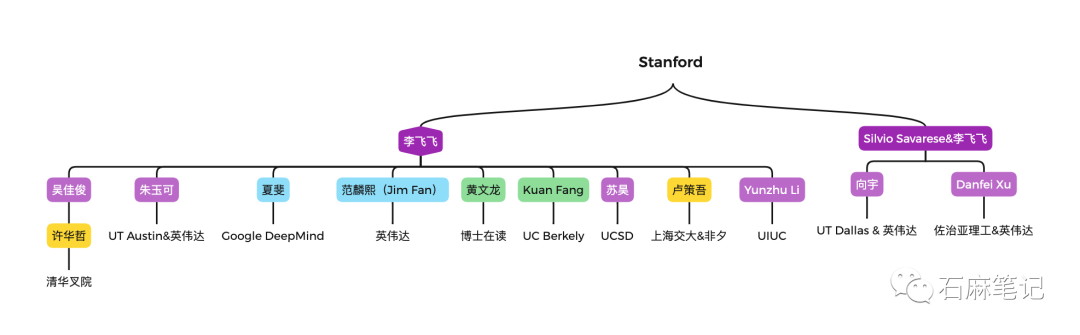
Chinese-Origin Researchers in Stanford’s Robot-Learning Network
Fei-Fei Li is one of the most influential Chinese-origin researchers in AI. She is a professor affiliated with Stanford’s Artificial Intelligence Laboratory, a member of the US National Academy of Engineering, the driving force behind the well-known computer-vision dataset ImageNet and co-director of the Stanford Vision and Learning Lab (SVL). She previously served as a Google vice president and chief scientist for AI/ML at Google Cloud. She received a bachelor’s degree in physics from Princeton in 1999 and a PhD in electrical engineering from Caltech in 2005. Her Google Scholar citation count in the original snapshot was 217,784.
Fei-Fei Li’s team has produced many results in embodied intelligence in recent years, including BEHAVIOR, a benchmark for evaluating embodied-intelligence models. BEHAVIOR-1K contains 1,000 activities selected from a large-scale survey of human preferences, eight scene categories, 50 fully interactive scenes, more than 1,200 object categories and more than 5,000 object models.
Her team also developed two robot-learning frameworks, RoboTurk and SURREAL, connecting high-quality datasets with advanced reinforcement learning. Sometimes described as an ImageNet for robotics, RoboTurk is a platform for crowdsourcing datasets of robot-control demonstrations. To address reproducibility in deep-learning algorithms and robotics research, SURREAL provides an open-source, scalable framework supporting advanced distributed reinforcement-learning algorithms for both on-policy and off-policy learning. Put simply, RoboTurk addresses data collection for robot learning, while SURREAL addresses reinforcement-learning training and evaluation using data. Two of Li’s students, Linxi (Jim) Fan and Yuke Zhu, were lead authors of the SURREAL framework.
This year, Li’s team introduced VoxPoser, a new result in embodied intelligence that the original article describes as a June release. It combines large language models (LLMs) and vision-language models (VLMs) to identify goals and environmental obstacles in 3D space and help robots plan actions. Real robots can then execute tasks without task-specific training. This does not mean that the underlying foundation models were never pretrained.
A brief introduction to SVL, the Stanford Vision and Learning Lab: Fei-Fei Li and her husband Silvio Savarese founded this lab. At the time of this article, it had two full-time faculty members, Li and her former student Jiajun Wu, and two adjunct faculty members, Savarese and Carlos Niebles, both working as AI scientists at Salesforce. Here the original’s “student” describes its broad research-network framing: Wu’s PhD was at MIT under Bill Freeman and Josh Tenenbaum, as detailed below; Li was not his PhD adviser.
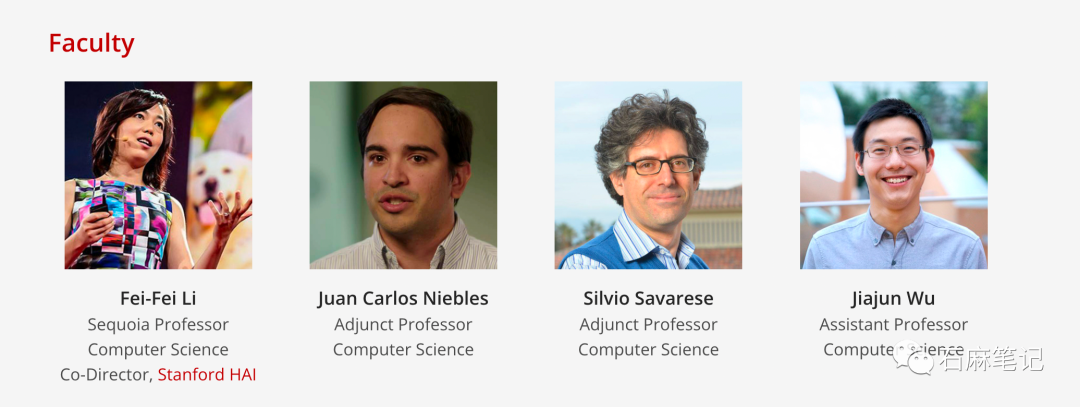
SVL Faculty
Within SVL, the People, AI & Robots Group (PAIR) specifically studies embodied intelligence. It develops general-purpose methods and mechanisms for robot perception and control, addressing complex problems at the intersection of computer vision, machine learning and robotics. Its algorithms and systems combine reinforcement learning, control-theoretic modeling and 2D/3D scene understanding to teach robots to perceive and interact with the physical world. Li’s SVL has trained a large number of Chinese-origin robot-learning researchers, whom I introduce below.
Jiajun Wu is an assistant professor of computer science at Stanford and a faculty member of SAIL and Li’s SVL. Inspired by human cognition, he studies machine perception, reasoning and interaction with the physical world. He earned his PhD at MIT under Bill Freeman and Josh Tenenbaum, after an undergraduate degree in Tsinghua’s Yao Class. Zhihu contains many legendary stories about his student days there, portraying him as an exceptionally gifted scholar. I heard him speak at this year’s WAIC in Shanghai, and my immediate impression was that very smart people speak extraordinarily fast. His Google Scholar citation count was 16,510.
Linxi (Jim) Fan is a research scientist at NVIDIA AI. He works on capable autonomous agents, with interests including foundation models, robotics and multimodal learning. He received his PhD at Stanford SVL under Fei-Fei Li. As first author, he led MineDojo, which won an Outstanding Paper Award at NeurIPS 2022. MineDojo is an open-ended learning platform for general-purpose AI built around Minecraft. He was also a lead author of SURREAL. Citation count: 4,280.
Yuke Zhu is an assistant professor of computer science at UT Austin, director of the Robot Perception and Learning (RPL) Lab and a senior research scientist at NVIDIA Research. RPL focuses on robotics and embodied intelligence. He earned his bachelor’s degree at Zhejiang University and master’s and doctoral degrees at Stanford, where he belonged to SVL and PAIR and studied under Fei-Fei Li. He is known for his contributions to SURREAL. One entertaining project he and his students worked on is a robot that cooks instant noodles. Citation count: 14,243.
https://sites.utexas.edu/hcrl/ (The original article cites UT Austin’s Human Centered Robotics Laboratory here; it is distinct from Yuke Zhu’s Robot Perception and Learning Lab.)
Danfei Xu is an assistant professor in Georgia Tech’s School of Interactive Computing and a part-time research scientist at NVIDIA AI. He works at the intersection of robotics and machine learning. He completed his computer-science PhD at Stanford under Fei-Fei Li and Silvio Savarese between 2015 and 2021, after a bachelor’s degree at Columbia. He directs Georgia Tech’s Robot Learning and Reasoning Lab (RL2). Citation count: 5,935.
Yu Xiang is an assistant professor of computer science at UT Dallas and previously a senior research scientist at NVIDIA Research. He earned his PhD at the University of Michigan under Silvio Savarese, worked as a postdoc with Dieter Fox at UW and was a visiting student researcher at Stanford SAIL. His undergraduate degree is from Fudan University. Citation count: 9,617.
Li previously served as chief scientist for AI/ML at Google Cloud. Her group maintains close collaborations with Google, where several of her students have important roles in robotics research. Examples include:
Fei Xia is a senior research scientist on Google DeepMind’s robotics team. He earned his PhD at Stanford under Silvio Savarese and Leonidas (Leo) Guibas, after a bachelor’s degree in automation at Tsinghua. His interests concern computer vision and robotics, including reinforcement learning, imitation learning and sim-to-real transfer. His recent work explores using foundation models for robot decision-making, and he contributed to Google’s PaLM-E, RT-1 and RT-2. Citation count: 4,514.
Wenlong Huang is a PhD student at Stanford SVL, advised by Fei-Fei Li. He earned his bachelor’s degree at UC Berkeley, where he studied from 2018 to 2021, and interned with Google Brain’s robotics team in 2022. He is the first author of VoxPoser and also contributed to PaLM-E. Citation count: 860.
Kuan Fang is a postdoctoral researcher at BAIR, working with Sergey Levine. He earned his PhD at Stanford under Fei-Fei Li and Silvio Savarese and his undergraduate degree at Tsinghua. He has worked at Google Brain, Google [X] Robotics and Microsoft Research Asia. His research aims to enable robots to solve a wide range of complex tasks in unconstrained environments by developing scalable, data-driven methods for perception and control. Citation count: 1,249.
Other distinguished students of Li have taken faculty positions at North American universities and begun establishing their own influence, including Hao Su at UCSD and Yunzhu Li at UIUC. I discuss them below. Her group’s research lineage also extends to Tsinghua and Shanghai Jiao Tong University: Huazhe Xu worked with Jiajun Wu during his Stanford postdoc, while Cewu Lu worked with Li during his. More on both below.
3. MIT CSAIL
MIT CSAIL’s strength in AI hardly needs explaining. In robot learning specifically, however, my impression is that it has not had a research cluster as dominant as Berkeley’s or Stanford’s. Chinese-origin robot-learning researchers trained at MIT are somewhat dispersed. I have made a preliminary map, probably far from complete, and welcome additions from readers.
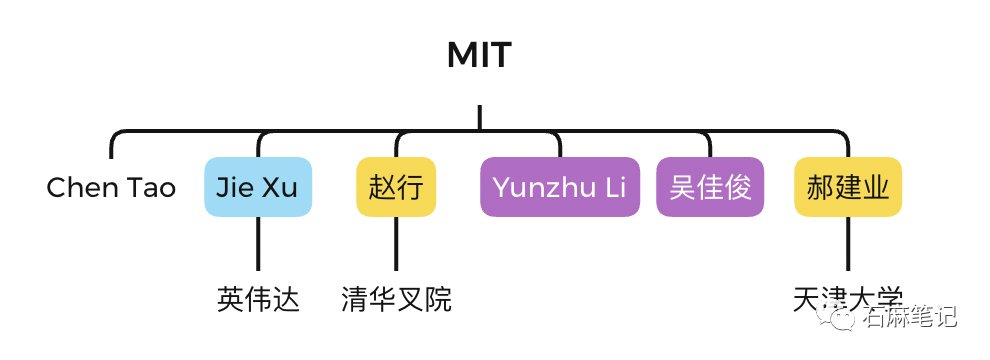
Tao Chen is a PhD student at MIT CSAIL, advised by Pulkit Agrawal. His interests center on robot learning, including dexterous manipulation, locomotion and navigation. He received a master’s degree from Carnegie Mellon’s Robotics Institute (CMU RI) in May 2019, advised by Abhinav Gupta, and previously worked as a research engineer at LX Robotics in Shanghai. He earned his undergraduate degree at Shanghai Jiao Tong University and has produced several impressive projects in dexterous manipulation with robot hands. His adviser, Pulkit Agrawal, who is Indian, is one of MIT’s strong AI + robotics researchers. Agrawal earned his PhD at UC Berkeley; his group includes several Chinese students who had not yet graduated when I wrote this article. Editor’s note: The Chinese original gives 2019 as Agrawal’s PhD year. MIT’s biography gives 2018; 2019 was the year he joined MIT’s faculty.
Jie Xu is a research scientist in NVIDIA’s Robotics Lab, led by Dieter Fox. He received his PhD at MIT CSAIL under Wojciech Matusik and his bachelor’s degree in computer science and technology at Tsinghua. He works at the intersection of robotics, simulation and machine learning, with interests in robot control, reinforcement learning, differentiable-physics simulation, joint optimization of robot control and design, and sim-to-real methods. A paper on dexterous in-hand manipulation that he coauthored with Tao Chen won the CoRL 2021 Best Paper Award.
https://taochenshh.github.io/projects/in-hand-reorientation
I discuss MIT-trained Hang Zhao and Jianye Hao in the China section below. Yunzhu Li and Jiajun Wu have already appeared in the discussion of Li’s group. Hao’s connection to MIT was through postdoctoral research.
4. CMU RI
CMU is exceptionally strong in traditional robotics. In AI + robotics, professors active in recent years include Abhinav Gupta, David Held and Deepak Pathak. Pathak, who is Indian, is another branch of the Berkeley research lineage: he completed his PhD there under Alexei (Alyosha) Efros and Trevor Darrell and worked with Pieter Abbeel as a postdoc. He has also been a researcher at Meta AI Research. He has recruited many Chinese students, from undergraduates to PhD students, but as a relatively young faculty member, his first PhD cohort had not yet graduated. Gupta, also Indian, works across vision, language and robotics. He advised Xiaolong Wang’s PhD and Tao Chen’s master’s degree. David Held is an associate professor at CMU RI and director of Robots Perceiving And Doing (RPAD). His work focuses on perceptual robot learning. He received his PhD at Stanford under Silvio Savarese and Sebastian Thrun and worked as a postdoc at Berkeley, making his academic lineage a branch of both institutions. One of Held’s PhD students, Xingyu Lin, is now a BAIR postdoc working with Pieter Abbeel; Lin’s undergraduate degree is from Peking University.
Guanya Shi has just joined CMU RI as an assistant professor and founded the Learning and Control for Agile Robotics (LeCAR) Lab. He received his PhD at Caltech in 2022 under Soon-Jo Chung and Yisong Yue, after a bachelor’s degree from Tsinghua in 2017. From 2022 to 2023, he was a postdoc at UW working with Byron Boots. Citation count: 867.
5. UW & NVIDIA
Dieter Fox is a professor in the University of Washington’s Paul G. Allen School of Computer Science and Engineering. He grew up in Bonn, Germany, and received his computer-science PhD from the University of Bonn in 1998. He joined UW in fall 2000 and leads both its Robotics and State Estimation Lab (RSE-Lab) and NVIDIA’s Robotics Research Lab. Citation count: 88,135. Chinese-origin researchers who have worked with him include his former postdoc Yu Xiang, introduced in the Stanford section, and Jie Xu, introduced in the MIT section.
Byron Boots is a professor at UW’s Paul G. Allen School and director of the UW Robot Learning Laboratory. He earned his PhD in Carnegie Mellon’s Machine Learning Department and completed a postdoc at UW under Dieter Fox. He has advised several Chinese-origin researchers, including former postdoc Siyuan Dong, now at Huawei, and Guanya Shi, now an assistant professor at CMU RI.
6. UCSD
Xiaolong Wang is an assistant professor in UCSD’s Department of Electrical and Computer Engineering. He was a postdoc at UC Berkeley with Alexei Efros and Trevor Darrell and received his robotics PhD at CMU RI under Abhinav Gupta. He studies how to learn 3D and dynamic representations from video and physical robot-interaction data, supporting robot-skill learning so that robots can interact effectively with diverse objects and environments in the real world. Citation count: 20,474.
Hao Su is an assistant professor of computer science at UCSD and director of its Embodied AI Lab. He earned his computer-science PhD at Stanford under Fei-Fei Li and contributed to ImageNet. His work leading projects such as ShapeNet and PointNet helped establish foundations for 3D deep learning. In recent years, he has focused on embodied-AI systems, leading development of the SAPIEN and ManiSkill infrastructure platforms and research on 3D foundation models for embodied intelligence. Citation count: 83,907.
7. Other North American Universities and Companies
UIUC
Yunzhu Li is an assistant professor at UIUC. Previously, he was a postdoc at Stanford SVL, working with Fei-Fei Li and Jiajun Wu. He earned his PhD at MIT CSAIL under Antonio Torralba and Russ Tedrake and his bachelor’s degree at Peking University. At UIUC, he founded the Robot Perception, Interaction, and Learning Lab (RoboPIL), working at the intersection of robotics, computer vision and machine learning. Citation count: 2,914.
Stanford
Shuran Song is an assistant professor at Stanford. Previously, she was an assistant professor at Columbia and head of its Artificial Intelligence and Robotics Lab. Her research focuses on computer vision and robotics. She earned her undergraduate degree at the Hong Kong University of Science and Technology. Citation count: 23,268.
Google Brain
Jie Tan is the technical lead of Google Brain Robotics’ locomotion and safety team. His research focuses on enabling robots to learn automatically the skills needed for complex real-world tasks. He earned his PhD in Georgia Tech’s Computer Graphics Lab, advised by Greg Turk and Karen Liu, after bachelor’s and master’s degrees at Shanghai Jiao Tong University. Citation count: 7,514.
Google DeepMind
Andy Zeng is a research scientist at Google DeepMind. He studies robot learning to enable machines to interact intelligently with the world and continually improve themselves. He earned bachelor’s degrees in computer science and mathematics at UC Berkeley and a computer-science PhD at Princeton. He contributed to Google’s PaLM-E robotics foundation model. Citation count: 7,819.
8. Tsinghua University
Yi Wu is an assistant professor at Tsinghua’s Institute for Interdisciplinary Information Sciences (IIIS). He earned his undergraduate degree in Tsinghua’s Yao Class and his PhD at UC Berkeley under AI pioneer Stuart Russell, also conducting reinforcement-learning research with Pieter Abbeel during his PhD. Before returning to China, he worked at OpenAI, where he helped develop the well-known reinforcement-learning hide-and-seek experiment with blue and red agents. His interests include deep reinforcement learning, multiagent learning, natural-language understanding and large-scale learning systems. He has done substantial work on reinforcement learning and alignment with human goals, aiming toward AGI by applying RL and alignment to LLM-based foundation models. Citation count: 7,310.
OpenAI
Yang Gao is an assistant professor at Tsinghua IIIS. He earned his undergraduate degree in Tsinghua’s Computer Science Department and his PhD at UC Berkeley under leading computer-vision researcher Trevor Darrell. During his PhD, he began exploring reinforcement learning with Sergey Levine, and he continued RL research as a postdoc with Pieter Abbeel—all prominent researchers in RL + robotics. His work combines computer vision and robotics, teaching robots to manipulate their surroundings through 'seeing.' A key problem in applying RL to robotics is the scarcity of real-world data. His projects EfficientZero and SpeedyZero address sample efficiency; the original article describes a 500-fold improvement over DQN. Citation count: 3,165. Editor’s note: Such sample-efficiency comparisons depend on the benchmark and evaluation setup. EfficientZero’s reported results were on Atari games; they do not establish a universal 500-fold gain for physical robots.
Huazhe Xu is an assistant professor at Tsinghua IIIS. He earned his bachelor’s degree at Tsinghua and his PhD at UC Berkeley under Trevor Darrell, and was a postdoc at Stanford SVL under Jiajun Wu. His primary interests are reinforcement learning, robotics and robot touch. Recent projects include RoboCraft, a system for manipulating deformable objects, work on improving compositional generalization and tactile sensors designed around the physical properties of materials. The original article associates these deformable-object systems with making dumplings. Citation count: 2,667. Editor’s note: The cooking demonstration linked below is RoboCook, a related but distinct project, rather than a project called RoboCraft.
https://hshi74.github.io/robocook/
Jianyu Chen is an assistant professor at Tsinghua IIIS. He earned his undergraduate degree at Tsinghua and his PhD at UC Berkeley under Masayoshi Tomizuka. He leads Tsinghua’s Intelligent Systems and Robotics (ISR) Lab, studying the intersection of AI and robotics to build advanced systems with high performance and intelligence. He also founded the humanoid-robotics company RobotEra. Citation count: 1,288.
Hang Zhao is an assistant professor at Tsinghua IIIS. He earned his bachelor’s degree at Zhejiang University and his PhD at MIT under Antonio Torralba, and previously worked as a research scientist at Waymo. He has produced substantial research in vision-based control, particularly autonomous driving. He founded Tsinghua’s multimodal-learning MARS Lab to explore a range of AI questions. He is especially interested in how machines can learn, reason and interact like humans using multiple sensory inputs. His research spans multimedia computing, autonomous driving, robotics and multiple sensors. Citation count: 13,455.
9. Peking University
He Wang is an assistant professor at Peking University’s Center on Frontiers of Computing Studies. He earned his undergraduate degree at Tsinghua and his PhD at Stanford under Leonidas J. Guibas, a member of the US National Academy of Sciences, the US National Academy of Engineering, and the American Academy of Arts and Sciences. He founded and leads the Embodied Perception and Interaction (EPIC) Lab. Grounded in 3D visual perception and robotics, EPIC focuses on perception and interaction for embodied robots in complex 3D environments, aiming to develop highly generalizable robot-vision and control systems in a scalable way. Its results span object grasping, functional manipulation, dexterous manipulation and object-navigation tasks. Wang also founded the humanoid-robotics company Galbot. Citation count: 1,762.
Zongqing Lu is an assistant professor in Peking University’s School of Computer Science and a Boya Young Fellow. He earned his bachelor’s degree at Southeast University and his PhD at Nanyang Technological University in Singapore. His main research interests are reinforcement learning and general-purpose agents. Citation count: 2,410.
Hao Dong is an assistant professor and PhD supervisor at Peking University’s Center on Frontiers of Computing Studies, which he joined in August 2019. His work focuses on generalizable robot-arm manipulation, robot vision and autonomous decision-making for mobile devices. He graduated from Imperial College London in fall 2019 under Yike Guo. Between 2012 and 2014, he and Guo cofounded a startup developing brain–computer interfaces. He also leads the Beijing Academy of Artificial Intelligence’s Embodied AI Center and is a member of Peng Cheng Laboratory. Citation count: 4,534.
10. Shanghai Jiao Tong University
Cewu Lu is a professor at Shanghai Jiao Tong University. He was a Stanford postdoc working with Fei-Fei Li and Leonidas J. Guibas and received his PhD at the Chinese University of Hong Kong under Jiaya Jia. His interests include computer vision, deep learning, deep reinforcement learning and robot vision. He is also chief scientist at the general-purpose intelligent-robotics company Flexiv. Citation count: 15,226.
Weinan Zhang is an associate professor at Shanghai Jiao Tong University. He received his PhD from University College London in 2016 and his bachelor’s degree in engineering from SJTU’s ACM Class in 2011. His interests include reinforcement learning, particularly multiagent RL, robotics, deep learning and data science. Citation count: 17,581.
11. Other Chinese Universities and Companies
Nanjing University
Yang Yu is a professor in Nanjing University’s School of Artificial Intelligence and a professor in its LAMDA group. I regard LAMDA as among China’s top one or two reinforcement-learning labs. He earned his bachelor’s degree in 2004 and his PhD in 2011 from Nanjing’s Department of Computer Science and Technology. His main interest is reinforcement learning, through which an agent learns autonomously from interaction with an environment to find near-optimal decision-making policies. He is the founder and CEO of the startup Polixir. Citation count: 4,856.
Tianjin University
Jianye Hao is an associate professor at Tianjin University and head of the Decision Making and Reasoning Lab at Huawei Noah’s Ark Lab. He earned his PhD in computer science and engineering at the Chinese University of Hong Kong in 2013 and his bachelor’s degree at Harbin Institute of Technology in 2008, and conducted postdoctoral research at MIT CSAIL. After returning to China in 2015, he established Tianjin University’s Deep Reinforcement Learning Lab. His primary interests are deep reinforcement learning and multiagent systems.
Tencent Robotics X
Founded in 2018, Tencent Robotics X develops next-generation robots for human–robot collaboration. It focuses on research and applications in three general-purpose robotics technologies—mobility, dexterous manipulation and intelligent agents—with an emphasis on multimodal mobile robots. In April 2023, it released new dexterous-manipulation research and introduced its self-developed TRX-Hand and TRX-Arm.
Tencent
Bidan Huang, corresponding author of the TRX-Hand dexterous-manipulation paper, is a senior researcher at Tencent Robotics X. Her primary interests include robot learning, control, grasping and manipulation. She received her robotics PhD from the University of Bath in 2015 and worked as a research associate at Imperial College London’s Hamlyn Centre for Robotic Surgery. Between 2012 and 2014, she was a visiting student at EPFL’s Learning Algorithms and Systems Laboratory. Her goal is to give robots human-level hand dexterity for manipulating objects in medical, industrial and everyday settings. Editor’s note: The original Chinese text describes the Imperial appointment as current. The published institutional biography places it in 2015–2018; it was a previous appointment.
In June 2023, Tencent Robotics X announced new progress in intelligent-agent research. By applying advanced pretrained AI models and reinforcement learning to robot control, it substantially improved the agility and autonomous decision-making abilities of Tencent’s robot dog Max.
Tencent
Lei Han, first author of the paper on controlling robots using pretrained models and reinforcement learning, is a principal research scientist at Tencent Robotics X and leads its Agent Learning Center. He previously served as an assistant research professor in the Department of Basic Science at Mississippi State University. He received his PhD at Peking University and spent two years conducting postdoctoral research at Hong Kong Baptist University under Yu Zhang and at Rutgers under Tong Zhang. His interests include large-scale statistical machine learning, reinforcement learning, optimization and multitask learning, together with applications in robotics, games, natural-language processing, computer vision and bioinformatics.
Yu Zheng joined Tencent Robotics X in September 2018 and is a principal research scientist and team leader in its Control Center. His interests include multicontact and multibody robotic systems, dexterous grasping and manipulation, quadrupedal locomotion and a variety of robotics algorithms.
12. Some Reflections
This article took a very long time to write—possibly longer than anything else I have written for my WeChat publication. Much of it was written in the air or at airports. Over the preceding two weeks, I took four business trips, and whenever a flight or airport wait gave me more than five spare minutes, I pulled out my laptop. As an investor whose work has largely focused on robotics, I am full of anticipation for AI + robotics. I would love to exchange ideas with founders and investors in this area, especially the researchers mentioned above and their students. A thought occurred to me: if I want to find you, I first need to know where you are. That is the purpose of this article.
References:
https://mp.weixin.qq.com/s/VHJs1zPV_Asdbpax-gjDvw
https://mp.weixin.qq.com/s/X60vzoPaEwuDFe2MH-24pA
https://people.ucas.edu.cn/~zhf
https://mp.weixin.qq.com/s/n6SDzKPnzdFgEtycjFKa_w
https://zhuanlan.zhihu.com/p/401682518
https://iiis.tsinghua.edu.cn/people/#jy1
https://mp.weixin.qq.com/s/l_Hl2Ko9phoX1WbX7SFzdA
http://cfcs.pku.edu.cn/people/faculty/hewang/
https://robotics-transformer2.github.io/
https://hshi74.github.io/robocook/
https://dblp.org/db/conf/corl/index.html
https://people.eecs.berkeley.edu/~svlevine/
https://cseweb.ucsd.edu/~haosu/index.html#_pub
https://zhuanlan.zhihu.com/p/81101138
http://people.eecs.berkeley.edu/~trevor/
https://people.csail.mit.edu/jiex/
https://www.zhihu.com/question/440111069/answer/1946083263
https://svl.stanford.edu/people/
https://faculty.cc.gatech.edu/~danfei/
https://cfcs.pku.edu.cn/people/faculty/haodong/index.htm
https://www.wolai.com/eyounx/93LfhvBvhx7XhwbZpSryoS
https://tencent-roboticsx.github.io/lifelike-agility-and-play/
https://arxiv.org/pdf/2304.05141.pdf