I first heard about Genesis a year ago and have been eagerly awaiting this new robot-simulation platform ever since. Today, after two years of development, it has finally been released publicly. I believe it has the potential to transform the robot-simulation ecosystem. At launch, I believed it should be the fastest and most accurate physics engine, with support extending beyond rigid bodies. The demonstration video is stunning. Those superlatives express my excitement and assessment at the time; speed and accuracy depend on the scene, solver and benchmark rather than one universal ranking.
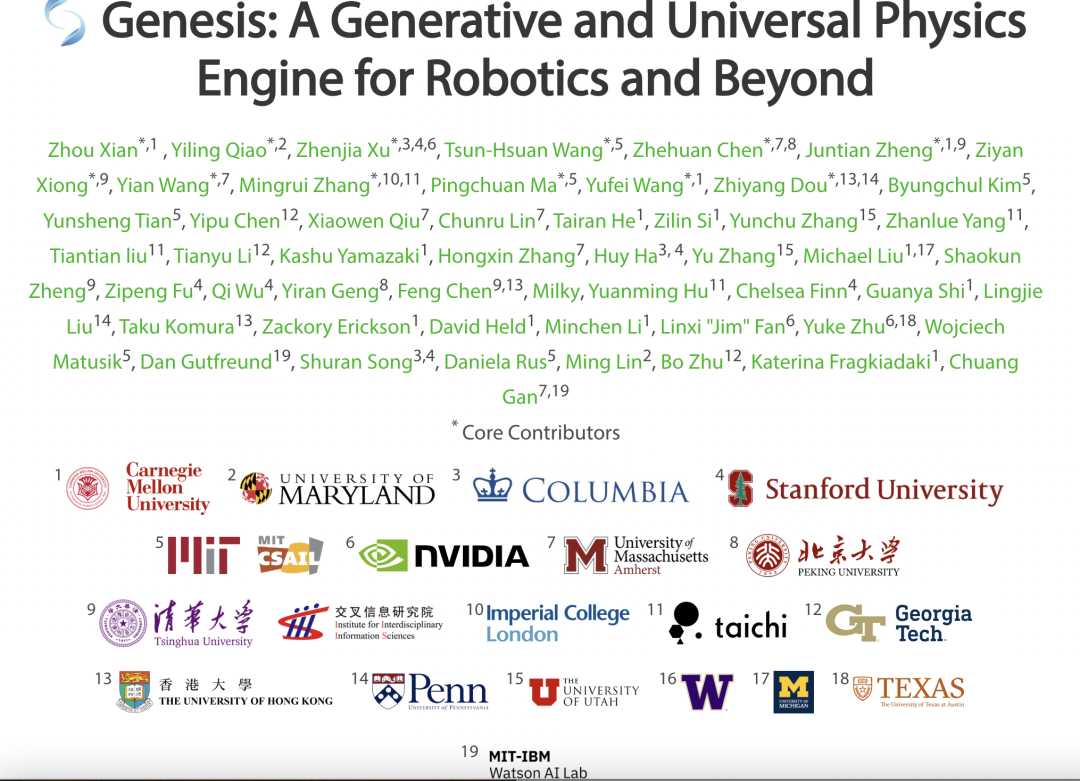
During the year before its release, I spoke several times with two principal contributors, Chuang Gan and Zhou Xian, asking them about differentiable physics engines, RoboGen and Genesis. I covered differentiable physics and RoboGen in detail in Robot Data EP8: Chuang Gan and Zhou Xian on RoboGen, Generative Simulation and Differentiable Physics. Genesis brings together excellent Chinese researchers in robotics and computer graphics across nineteen institutions, according to the original introduction. It is an exceptionally difficult collaboration and offers a ray of light for the somewhat neglected route of simulation-based general manipulation.
Hearing Chuang Gan and Zhou Xian first describe this work felt like discovering a new continent. It led me to study related work on differentiable physics. To better understand Genesis's potential influence on robot simulation, I strongly recommend two earlier articles: Robot Data EP8: Chuang Gan and Zhou Xian on RoboGen, Generative Simulation and Differentiable Physics, which discusses differentiable engines and RoboGen as a component of this broader vision; and Let's Talk About Sim, Part I: The Robot Simulator Ecosystem, which surveys the simulation landscape.
In robot manipulation today, the prevailing consensus favors real-robot learning, while simulation has been left on the sidelines. Genesis's release and the attention it attracts may warm up that neglected bench again. Combining publicly available launch information with my earlier interviews with Chuang Gan and Zhou Xian, I have written this introductory account in the hope that more people will pay attention to the project. The discussion retains its December 2024 release context.
Original article outline
Contents
↓
1. What is Genesis?
2. Core differences from other simulation platforms
Differentiability
Realistic rendering
Robot-data generation
Simulation acceleration
3. Applications beyond robotics
4. The sim-to-real gap
5. Simulation and differentiable physics
An introduction to differentiable physics engines
6. Why open source?
7. Some reflections
1. What is Genesis?
Genesis is presented as a generative and differentiable physics platform for general-purpose robot learning. It aims to unify simulation across different materials and support a broad range of robot tasks. As next-generation simulation infrastructure, its broader vision combines generative AI with physics-based simulation to create abundant, diverse data, allowing robot agents to learn many skills in a wide variety of environments. Editorial clarification: the original says it 'fully supports differentiability.' Full differentiability is a design goal, not blanket support across every released solver and interaction. The official documentation identifies differentiable MPM and tool interaction, with support differing across components. 'Unlimited data' describes repeatable generation, subject to compute and the model's coverage.
The platform's vision has four parts: a general-purpose physics engine rebuilt from the ground up to simulate varied materials and phenomena; a lightweight, extremely fast, easy-to-use simulation interface in Python; an efficient photorealistic rendering system; and a generative data engine that turns natural-language requests into different kinds of data for different applications. These describe the overall architecture and roadmap; the first public release should not be read as opening every generative capability shown in the demonstrations.
Genesis is the name for the whole framework or platform. Its core has two layers. The lower layer is a unified physics engine that simulates different physical materials for different tasks. Fast simulation lets us generate demonstrations more quickly and improves the efficiency of the overall workflow.
The upper layer is a generative-agent framework containing independently developed modules. We bring together stages such as complex-scene generation, automatic task generation and policy learning. The vision also supports generating human characters and robot morphologies. Our aim is to generate almost everything the workflow needs and build a comprehensive generative system. Integrating these separately developed modules into one platform is what we call Genesis.
Each module is developed independently—for example, robot-policy generation, scene generation and motion generation. Each has its own method for generating a particular type of data. A coordinating agent receives a request, determines what the user needs and decides which content to generate. It then invokes the relevant modules. Their outputs are coupled, and the agent can check the generated scene and further improve the result.
For example, scene generation uses diffusion models, but the diffusion model is the underlying network responsible for generating content. Around it, we need a method to decide the space in which generation occurs and ensure that its output becomes an interactive scene. Motion generation similarly uses underlying models such as Transformers. Each is a separate network carrying out a particular task.
The upper layer was not yet fully implemented at the time of this release. Completing it could greatly advance robotics. In the initial framework, we are bringing the modules together, and each has considerable room to improve. This is a description of development and integration, not a claim that the complete generative-agent system was included in the publicly released physics engine.
2. Core differences from other simulation platforms
Differentiability
Most existing physics engines do not support differentiability. In my account, that limits the available solutions to RL or motion planning. For background on physics engines, see Let's Talk About Sim, Part I: The Robot Simulator Ecosystem. From the perspective of the tools available to us, that is a significant limitation. Editorial clarification: the original says that RL and motion planning are the only options. Trajectory optimization is still possible using analytic models, finite differences or approximate derivatives without a built-in differentiable engine.
Robotics researchers know that trajectory optimization is highly efficient, more efficient than RL. Yet developing suitable differentiable models has a high technical barrier, which has slowed progress. I believe resolving it could be revolutionary for robot learning. RL is widely used to learn skills in simulation, but the vast majority of robot-learning researchers do not consider it a particularly efficient way to learn those skills, yet have no better alternative. We hope to build an efficient differentiable system. The path is long and the engineering work considerable, but we think it is a path we must pursue. These efficiency comparisons and expectations are the researchers' position, rather than a universal ranking of all learning methods.
Realistic rendering
Through Genesis, we want to build a simulator covering rigid bodies, deformable bodies and many specialized materials, together with good rendering. This brings us back to the question of how to construct a virtual world where robots can learn and apply that learning to reality. Turning virtual experience into real capability is our mission. Robotics' major bottleneck is data. Many people collect it through teleoperation, but that is difficult to scale, so I place more faith in simulation data. The challenge is that writing a physics engine has a much higher entry barrier than building a teleoperation setup.
Many robot labs choose teleoperation because it is easier to get started. Whether it is the final route is another question. Simulation today feels to me a little like deep learning in the 1980s: the barrier seems high, and relatively few people are willing to invest in it. We are prepared to work patiently on something we believe could transform the field, even if it takes three to five years or longer. We still believe that simulators and differentiable simulation can address the fundamental question of where robot data will come from.
Robot-data generation
Over the past six months, we have developed a broader vision. We realized that Genesis is more than a physics engine: its ultimate purpose is to generate many kinds of data automatically. Beneath it is the engine stack we rebuilt; above it is a generative-agent framework.
We have done substantial work on generation: scenes, tasks, reward functions, articulated objects and robot morphologies. We are building a unified agent framework to invoke these modules. The idea is that users describe their needs in natural language, and the platform generates static environments, objects and even dynamic policies. This remains the broader generative vision described in the interview, rather than a promise that every module shipped at launch.
Simulation acceleration
A difficulty with CPU-based simulation is the time required to produce the many samples needed for useful learning. NVIDIA's GPU-accelerated approach allows thousands of environments to run simultaneously. It does not eliminate RL's sample-efficiency problem, but it significantly reduces the wall-clock cost. As GPU acceleration developed, we saw new breakthroughs in efficiently learned skills. In the comparisons discussed here, NVIDIA's approach was twenty to thirty times faster than the preceding generation. Editorial clarification: the original conflates simulator speed with sample efficiency. Faster execution supplies samples sooner; it does not by itself reduce how many samples an algorithm needs.
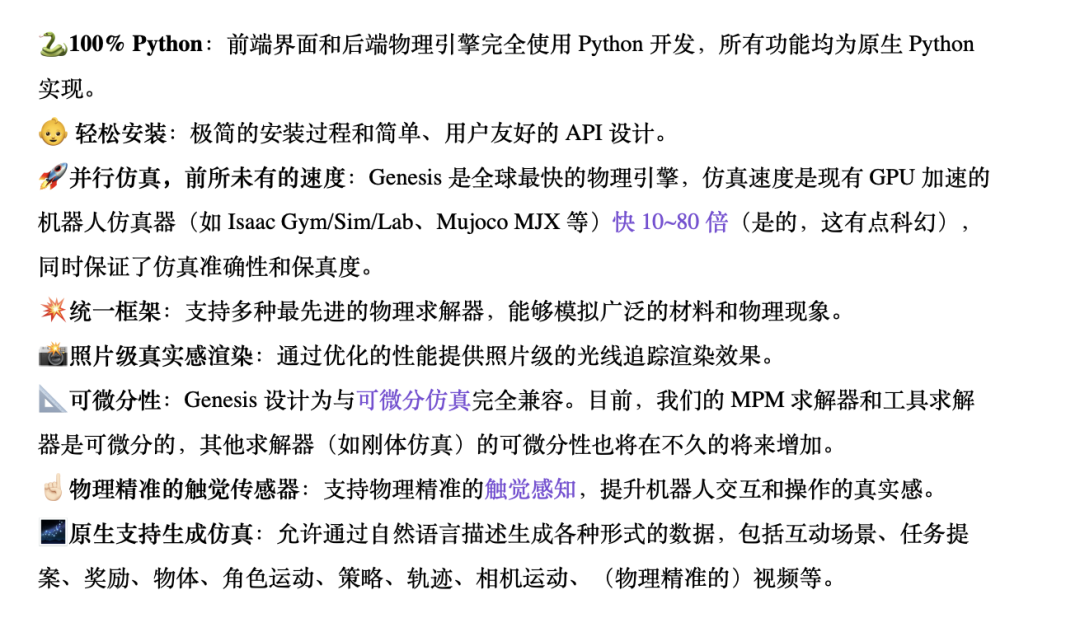
In our latest engine, Genesis, we report speeds twenty to fifty times faster than the NVIDIA system in the settings being compared. The improvement is not only speed: we support simulation of different materials and have redesigned the underlying framework and its application interface. Internal users have begun moving from earlier systems and found substantial improvements in ease of use. The speed figures are the team's launch-era comparisons, not a guarantee for every task, solver, rendering setup or hardware configuration.
Some existing simulation systems are complicated: a feature may pass through more than ten layers of function calls and require a great deal of code. Our system simplifies that workflow. Many operations can be invoked with a single line of code, improving development efficiency and the user experience. The Genesis project page also describes its differences from other simulators, as shown below.
3. Applications beyond robotics
We recently realized that this platform could help other fields, too. Although we began by trying to supply robotics data, those data formats are general. Robotics needs static information, such as task descriptions, environment features and interaction specifications, as well as dynamic information, such as a learned policy interacting with the changing world. Physics-based forward simulation can generate many kinds of dynamic data. These formats could support a broad range of applications.
Robot policies and demonstrations
For related background, see Robot Data EP8: Chuang Gan and Zhou Xian on RoboGen, Generative Simulation and Differentiable Physics.
We need not restrict the unified system to robotics. Video generation is an easy example. Consider how people make a film: rather than generating frames independently and stitching them together, they construct a three-dimensional scene, place actors in it, have a director guide their actions, and design the camera parameters and trajectory before capturing the scene. We can reproduce that process virtually. The contrast concerns a scene-based production workflow; it should not imply that every diffusion-based video model generates frames independently.
Generating dynamic 4D physical worlds
A powerful physics engine, together with an advanced renderer—we have integrated one—could recreate that production process inside a virtual world. The same infrastructure could then serve both robotics and video generation, greatly broadening its applications.
Beyond robot data, the framework's vision includes generating character motions and facial expressions, as well as parameters such as lighting intensity, camera focal length, camera paths and movement speed. It could generate many types of data, which could then be filmed virtually to produce videos with physics-based dynamics. 'Physically accurate' in the original expresses the intended benefit; every simulation remains an approximation of its physical model.
Character-motion generation
Speech audio, facial animation and emotion generation
I personally think this is a new video-generation paradigm. It could generate videos directly and also use the underlying generated data to train learning-based models. Natural-language descriptions could control individual scene elements: a character could enter from a specified location at a particular time, or the camera could cut in a particular way. That would let us align the resulting data at a very fine level of detail.
Generating 3D, fully interactive scenes
Open-world articulated-object generation
This approach could align language descriptions and generated video closely, producing paired data of much higher quality than the rough language–video alignment common today. Such data has many potential uses beyond our initial application. Robotics remains our original and main goal, but we could also generate dynamic 4D video data, especially interactive scenes rendered from different viewpoints, and multimodal data. We believe it could be useful across many fields and open further possibilities. The comparison expresses the researchers' vision rather than a quantified evaluation of every competing dataset.
4. The sim-to-real gap
I want to discuss the gap at several levels. First, I think people overlook a key point: the issue is not essentially a scientific one. Simulation alone cannot solve robotics; simulation and reality have to be combined. Each has its own difficulties. Simulated physics cannot match reality perfectly. Real-world learning faces limited scalability, incomplete data modalities and difficulties collecting closed-loop experience; demonstration collection often supplies successful trajectories without covering the full process. Ultimately, we need to bring the two together. The original's statement that the gap is 'not essentially scientific' is the speaker's framing, not a denial that modeling and transfer pose scientific questions.
As for the balance between the two, I see real-data scalability as the greatest challenge. Real data is accurate, but cannot expand without limit. Simulation can scale by adding compute. Although it cannot perfectly reproduce reality, it can provide abundant, varied data for broader exploration. That scalability is still constrained by computing resources and the simulator's physical coverage.
If we eventually have a unified foundation model, simulation data could supply rich training data from a broad distribution and help build basic common sense about physical interaction. More precise real-world data could then fill the gaps, completing the loop.
Let me explain this from another angle. The biggest challenge behind the real-data/simulation-data gap is that real data is difficult to collect and expand at scale. In the interview, I describe its quality as 'over 90%,' yet scale limitations prevent it from covering every scenario. Simulation can provide enormous, diverse datasets despite differences from reality, enriching model training. Real data would then add the finishing touches, supplementing and calibrating simulation. The 90% phrase is an informal quality assessment without a defined metric; it is not a measured fidelity score.
Second, reducing the difference between simulated and real data is a technical challenge. Improving realism in physics and sensor outputs is a key direction. For example, we work on physics-based tactile sensing, which had not been available in the simulation setups under discussion. Real feedback and optimization can make simulated sensor-deformation observations closely match physical sensors. Improving this fidelity is an ongoing goal, not a claim that no previous simulator ever supported tactile sensing.
However, exact matching is not always necessary. Introducing enough variation lets us generate diverse simulated worlds, rather like parallel universes with different physical properties. Data from those worlds can form a broad, smooth distribution. An individual sample may not exactly correspond to a real-world state, but sufficient useful diversity can help a robot handle many possible conditions.
At a philosophical level, I do not see the gap between simulated training and real deployment as a real “problem”: different environments naturally differ. If I teach you to grasp a pen, the skill may not transfer perfectly to another pen or a new scene. The gap arises not just from comparing simulation with reality but from the underlying differences between environments.
There are two levels here. First, moving from one parallel universe—simulation environment A—to another—real world B—inevitably introduces a gap, and we should keep making it smaller. Second, what makes that gap a problem? Many people have not thought deeply about this. With a general agent or general robot, would the gap still obstruct transfer from universe A to universe B, or could the agent adapt and overcome it? That is a central question worth exploring.
Imagine a thought experiment: you are a person with strong motor skills, and I place you on the Moon or in a completely different physical environment. Even though its physics differs greatly from what you are used to, you could adapt quickly using your basic understanding of the world. This is the sort of rapid adjustment that physical common sense can enable.
If we had a human-like AI with a strong physical understanding, I believe it could learn the real world's rules quickly with a small amount of real-data fine-tuning. We have not achieved that because today's policies are usually designed for specific tasks and lack general physical understanding. As simulation data becomes richer and foundation models develop, a generalist agent may be able to adapt quickly and carry out real-world tasks effectively.
There are also two technical explanations for today's gap. First, existing physics engines have limits and cannot accurately model many complex phenomena. The robot-simulation setups discussed here emphasize rigid objects, while complex deformable materials and fluid dynamics receive weaker support. Improving those capabilities is one of our aims. Second, platforms such as SAPIEN can depend on an underlying NVIDIA physics stack, limiting how readily users modify some of its internal models. Editorial clarification: the original calls NVIDIA's engine closed source and says its physical parameters cannot be customized. PhysX is open source and exposes many configurable parameters; the valid concern is flexibility and access within a particular simulation stack, not a blanket lack of source code or parameter control. Nor is rigid-body simulation limited to steel.
For example, we might want to simulate a steel ball bouncing and adjust its material behavior to reproduce elasticity and energy dissipation. If the available models or exposed controls are insufficient for that exact behavior, simulation can differ substantially from reality. Our proposed solution is an open, adjustable physics engine to which people can contribute and whose models they can modify. We can use real observations to fit and improve those models and bring simulation closer to reality. Greater control can help narrow the gap. Existing engines also expose restitution, friction and other properties; the original's claim that these cannot be adjusted at all is too categorical.
Although a gap remains, improving physics engines and making their models more open and adjustable could reduce it, helping general agents transfer more smoothly between simulation and reality.
5. Simulation and differentiable physics
Simulation is an important branch of computer graphics, alongside rendering. As a robotics researcher, I can sense that many practitioners find simulation intimidating because it involves substantial underlying mathematics and graphics knowledge. Without familiarity with those principles, people can struggle with existing tools and become stuck. The core issue is the lack of an effective bridge between graphics and robotics. We want to bring experts in both fields together so that they communicate, understand each other's needs, and develop the ecosystem through continued iteration and improvement.
We have to admit that building a robot-simulation engine is very difficult, and only a relatively small group knows how to do it. Graphics is specialized; simulation is one of its subfields, and differentiable simulation is narrower still. Its research and application community is therefore limited. Progress often requires innovations in underlying algorithms, knowledge that robot researchers may not possess.
Research on simulating complex material interactions, such as fluids and deformable bodies, has also been a relatively new emphasis in the robotics context discussed here. Much of the simulation work familiar to robot researchers has focused on rigid-body interaction. That history makes newer, more complex simulation techniques harder to adopt. This is not a claim that fluid and deformable-body simulation are new to computer graphics as a whole.
A central challenge in differentiable simulation is obtaining useful gradients and using them to accelerate policy optimization. This is still exploratory: there is no mature framework or generally accepted conclusion resolving the issues discussed here. Researchers are finding their way, and the direction contains substantial uncertainty.
Advancing simulation, particularly its mathematical and algorithmic foundations, requires many breakthroughs. That is the truly challenging work. We think about new algorithms every day, but the process is uncertain: until we implement them, we cannot know whether they will work.
An introduction to differentiable physics engines
What is simulation? Start with an object's state, let the robot take an action and predict the next state. This state–action–state process is forward dynamics or forward simulation. For a task, we can evaluate progress toward the goal and assign a reward, much as in RL: did the action bring us closer or move us farther away? Without accessible simulator gradients, searching for a good trajectory can be inefficient and require tens or hundreds of millions of samples in some settings. Editorial clarification: the original calls forward simulation itself a search problem. Forward simulation evaluates dynamics; the separate search or optimization procedure uses those evaluations to choose actions.
Differentiable simulation supplies gradient information, letting us optimize actions and parameters through gradient-based methods to maximize reward or minimize loss. Derivatives through successive state–action–state transitions guide the optimization. Without those derivatives, we can use search or approximate gradients. I believe that using these gradients must produce better, faster solutions. Editorial clarification: the original says every gradient is exact and performance is necessarily better and faster. The gradients belong to a discretized numerical model, with contact and other approximations; they do not guarantee a global optimum or a universal speed advantage.
Explanation: a differentiable physics engine simulates physical systems while allowing derivatives of outputs with respect to relevant inputs or parameters to be computed. Traditional engines use mathematical models and physical laws to approximate motion and interaction, but often do not expose gradients convenient for learning. A differentiable engine introduces differentiable models or numerical techniques to make those derivatives accessible. Nonsmooth contacts and the distinction between modeled and real physics still matter.
Our work began in collaboration with Yuanming Hu's Taichi project. Differentiable simulation is an important direction in computer graphics, often aimed at making simulation more accurate and efficient. In robotics, our concern is how to learn skills more efficiently, using gradients to guide skill acquisition.
For example, in our 2021 PlasticineLab collaboration with Yuanming Hu, PPO and other RL methods learned inefficiently on the evaluated tasks, while our gradient-based method was several orders of magnitude more efficient. This convinced us to build a differentiable simulation system for robot skill learning. An efficient learning method lets us collect many demonstrations in simulation and then pursue real-world skill transfer. Our overall logic is to build powerful differentiable physical simulation, generate abundant manipulation data, train a foundation model for skill learning, and learn an adaptive policy to transfer those capabilities to reality. The efficiency advantage refers to the tested benchmarks rather than every robot-learning task.
Some tasks are frustrating with RL: we train for a long time and still cannot find a useful policy. In our experience, our differentiable engine can sometimes find one in half an hour. That is why I regard differentiable physics as a more effective way than RL to obtain skill policies. But many simulators do not expose the gradients we need, which is a pain point. In the interview, I argue that without differentiability we have no other solution, only RL or motion planning, and no trajectory-optimization option. The entry barrier is high; I estimate that fewer than a hundred people worldwide can write a differentiable robot-physics engine. This motivated Genesis: bring together Chinese researchers with that expertise to tackle the problem. The mathematical and programming demands are substantial, and even in graphics, differentiable simulation can be hard work with little recognition. Editorial clarification: the half-hour figure and expert count are the speaker's examples and estimates. Despite the original's wording, lack of built-in differentiability does not exclude trajectory optimization using other derivative methods.
Robot simulators face two main difficulties. One is learning skills faster; differentiable simulation can find good policies quickly for some tasks. The other is reducing the sim-to-real gap. Differentiability can help align simulation and reality, distinguishing our workflow from one using PyBullet without accessible gradients. Domain randomization is widely used in that setting, but its choices can be difficult to control. Differentiable simulation offers another benefit: calibrating simulated behavior with real data, such as fitting the simulator to a real-world video. Domain randomization is not the only calibration method available in a nondifferentiable simulator, despite the original's categorical description.
Our broader goal is to give robots a world model. Why do humans learn skills quickly? They have a model of the world. I have long believed robot intelligence should come from world models: understanding state–action–state transitions and efficiently planning action sequences. I have consistently believed we need to build a powerful differentiable physics engine to serve as the robot’s brain and support learning many skills. Of course, a world model can also be learned from reality. The common aim is to build a brain with a broad understanding of the physical world, rather than one isolated skill. I believe genuine generalization requires that kind of physical modeling.
For a review of differentiable-simulation papers, see Robot Data EP8: Chuang Gan and Zhou Xian on RoboGen, Generative Simulation and Differentiable Physics.
6. Why open source?
The first release focuses on fully open-sourcing the underlying physics engine. We believe it offers substantial advantages over existing engines. The version we have just released makes important advances in performance, scalability and flexibility. We plan to keep optimizing and extending it, improve the engine, strengthen its integration with other modules and support more complex applications. The original says it is far ahead of every available engine in all respects; that is the team's launch-era assessment, not an independently established universal comparison.
One of my motivations is what I see in computer graphics. The field has produced impressive achievements, with new papers constantly demonstrating another scene or phenomenon: bread expanding in an oven, a steak being cut, even the fibers of braised pork changing as it is sliced. Yet the community can be relatively closed. People emphasize spectacular visual demonstrations, while many results remain at the paper or demo stage. Code is often not released, and released code can be difficult to understand and use. The technology progresses but does not become widely accessible. I think a major effort is needed to integrate these impressive techniques into an easy-to-use framework that benefits more people. This describes the speaker's experience, not every graphics project.
Over the long term, we will keep adding new techniques and complex physical effects to the framework, working toward reconstructing the physical world. The early system cannot yet model something as intricate as slicing braised pork, but it can already provide relatively complete simulations of effects involving deformable materials, fluids and clothing.
7. Some reflections
I have followed Genesis for more than a year. As the person behind Smart Note, I may be one of the people outside the robot-learning academic community who has watched its development and release most closely. So I am truly excited today! From the first time I heard the idea, I felt that it might overturn the existing robot-learning paradigm.
End-to-end imitation learning on real robots is a mainstream route with considerable support today. But many questions remain unanswered: how much real-robot data is needed to reveal useful scaling behavior, and how do we collect that enormous quantity? Could there be a completely different, disruptive route, such as transforming simulation? Genesis may not be the answer, but at least it has a chance to become the answer.
In the recent conversation Podcast: RL and Control—Toward 99.9x% Robot Reliability, Jianlan Luo mentioned Moravec's paradox. Tasks that seem simple to people, such as perception and motor control, are extremely difficult for machines; tasks that seem intellectually demanding, such as logical reasoning and arithmetic, can be comparatively straightforward. Moravec attributed this asymmetry to evolution: sensorimotor skills developed over vast evolutionary timescales and became deeply embedded in biological systems, while explicit logic and mathematics are much more recent developments. The paradox concerns that historical contrast, not a claim that every reasoning task is easy for AI.
Human and animal physical intuition is the outcome of an immense evolutionary history, reaching back through the age of dinosaurs and far beyond; it has become instinct. For a silicon-based 'being' such as a robot, are millions, tens of millions or hundreds of millions of real-world demonstrations enough to build an analogous physical instinct? Can those datasets alone supply the world-model intuition that biological organisms acquired over hundreds of millions of years? Editorial clarification: the original describes this as 'trillions of years.' That timescale is erroneous; the question concerns the long evolutionary history of physical intuition, not a literal trillion-year chronology.
If so, that would feel rather unfair to carbon-based life! In my view, a silicon-based being's physical intuition should arise through a powerful, efficient computational mechanism, operating in ways we do not readily understand. Genesis at least has some of the ingredients for that mechanism. What comes next depends on whether more people are willing to invest their time and effort in this route and make breakthroughs together.
References
Genesis
https://genesis-embodied-ai.github.io/
https://genesis-world.readthedocs.io/en/latest/
Zhou Xian's website
Chuang Gan's website
https://people.csail.mit.edu/ganchuang/